Understanding Shared Memory Systems in Parallel Programming
Shared memory systems allow multiple processors to access a single memory space, facilitating communication between threads. These systems can accommodate one or multiple memory units per processor and help address memory contention issues. They are favored for their simplicity, particularly in frameworks like OpenCL and CUDA, which leverage shared memory for efficient parallel processing. With advancements in GPU technology, the importance of optimizing memory bandwidth and utilizing shared memory as a programmable cache has become essential for maximizing computation performance.


Understanding Shared Memory Systems in Parallel Programming
E N D
Presentation Transcript
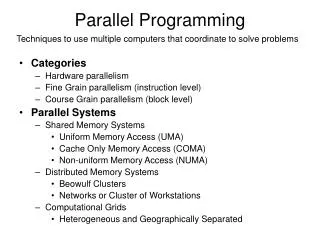
Programming of parallel systems Shared memory systems
What is a shared memory system • Single memory space accessible to the programmer • Processor communicate through the network to the memories • Might have one or multiple memory per processor [1] • If there is less memory than processor • Memory contention • All processor can write to the same memory at the same time
Examples of shared memory system • Shared memory systems are popular because of their ease of use. • CPU • Central processing unit • Shares the main memory among many processor to provide a way for communication between threads. • GPU • Graphics processing unit • Typically runs hundreds to thousands of threads in parallel organized in SIMD blocks. [2] • EX: ATI Radeon™ HD 4870 Architecture has 800 threads in 10 SIMD core [3]
Frameworks using shared memory for massively parallel systems • Due to the massive number of threads, applications have to be rewritten • OpenCL (Open Computing Language) [4] • Royalty Free • Originally developed by Apple, it was submitted to the non-profit Khronos Group • Heterogeneous computing, same code run CPUs, GPUs and other • CUDA (Compute Unified Device Architecture) • Proprietary to NVIDIA video cards • Has an API to run OpenCL on CUDA
CUDA vsOpenCL - performance [5] [6] Benchmarks were run using the same hardware and code
CUDA memory types 1/2 • Device memory – global memory • shared • large DDR5 memory (> 1GB) • off-chip - no cache - slow • Texture cache • opaque memory layout optimized for texture fetch [7] • Free interpolation • off-chip - cached
CUDA memory types 2/2 • Constant cache • Off-chip • Cached • Slow • Small (8KB) • Shared memory • One per multiprocessor • On-chip • Fast (one clock cycle) • Small (16KB) • Can serve as a cache for the global memory
Support for shared memory in hardware • Two types of shared memory • Global memory • Shared among the multiprocessor • No cache ... cache coherent • Support for atomic operations • Shared memory • Not a truly shared memory, because it is local to a multiprocessor • Support for atomic operations • Often serve a manual cache for the global memory • The program explicitly write to the shared memory • Private to a multiprocessor, shared between its threads
Memory bandwidth 1/4 • The memory is often the restricting factor in a system • Using a single bus and a single memory module restricts the system scalability [8] • Only one processor could access the memory at one time • Leads to serialization • Solution on the GPU: • Use a LARGE memory bus width such as 384-bit. [9] • This can lead to 48 byte read in parallel • Use a hardware scheduler to send the right data to the right thread. • There is no shuffling, first thread gets the first 4 byte, and so on. • Software is responsible to read continuous data
Memory bandwidth 2/4 • For a GeForce 480 GTX, theoretical scenario [9] • The Memory Bandwidth can be as high as 177.4 GB/sec • The performance can be as high as1.35 Tflops • 1350 * 109 floating point operation per second • Float = 4 byte • Load 44.35 * 109 float/s • Process 1.35 * 1012 float/s • To have maximum utilisation we need • 1,350 * 109 / 44.35 * 109 = 30.5 operations per memory access
Memory bandwidth 3/4 • In the GPU, the memory bandwidth is really high (177.4 GB/sec) and it is determined by the type of card • The bandwidth between the CPU and the GPU is limited by the communication link • PCI-Express in most cases • Max speed: 8GB/s • Important to minimize the communication between the CPU and the GPU
Memory bandwidth 4/4 • In practice it is almost impossible to achieve maximum throughput because of the memory alignment requirements. • Solution: Shared memory • Acts as a programmable cache • It is possible to order the reads from the global memory and do the computation on a faster smaller memory
Example of CUDA code __global__ void example(float* A, float* B) { inti = threadIdx.x; if (i > 0) B[i] = S[i - 1]; } int main() { float* A, * B; cudaMalloc(&A, 1000); cudaMalloc(&B, 1000); example<<<1, 1000>>>(A, B); } Takes 3 second
Code with shared memory __global__ void example(float* A, float* B) { __shared__ float S[1000]; inti = threadIdx.x; S[i] = A[i]; __syncthreads(); if (i > 0) B[i] = S[i - 1]; } int main() { float* A, * B; cudaMalloc(&A, 1000); cudaMalloc(&B, 1000); example<<<1, 1000>>>(A, B); }
Example I ran that simple program on my computer Versus the simple solution without shared memory GPU: GeForce 8800 GTS
Explanation 2 load 32 load
The state of the art graphics cards that have come out in April 2010 now use caches for global memory • Two types of caches • L2 cache shared between multiprocessors • Cache-coherent • L1 cache local to a multiprocessor • Not cache-coherent
Conclusion • CUDA vsOpenCL • Fast, easy: CUDA • Portable: OpenCL • Quick development • Started in 2008 • Added a cache recently • Memory bandwidth limitations are major • Use larger memory bus • Use caching
References [1] Dandamudi, S.P.; , "Reducing run queue contention in shared memory multiprocessors," Computer , vol.30, no.3, pp.82-89, Mar 1997 doi: 10.1109/2.573673 URL: http://www.ieeexplore.ieee.org.proxy.bib.uottawa.ca/stamp/stamp.jsp?tp=&arnumber=573673&isnumber=12418 [2] http://developer.download.nvidia.com/compute/cuda/3_1/toolkit/docs/NVIDIA_CUDA_C_ProgrammingGuide_3.1.pdf [3] http://developer.amd.com/gpu_assets/GPU%20Computing%20-%20Past%20Present%20and%20Future%20with%20ATI%20Stream%20Technology.pdf [4] http://www.khronos.org/developers/library/overview/opencl_overview.pdf [5] Weber, R.; Gothandaraman, A.; Hinde, R.; Peterson, G.; , "Comparing Hardware Accelerators in Scientific Applications: A Case Study," Parallel and Distributed Systems, IEEE Transactions on , vol.PP, no.99, pp.1-1, 0 doi: 10.1109/TPDS.2010.125 URL: http://www.ieeexplore.ieee.org.proxy.bib.uottawa.ca/stamp/stamp.jsp?tp=&arnumber=5482576&isnumber=4359390 [6] http://arxiv.org/abs/1005.2581v2 [7] http://www.math.ntu.edu.tw/~wwang/mtxcomp2010/download/cuda_04_ykhung.pdf [8] Dandamudi, S.P.; , "Reducing run queue contention in shared memory multiprocessors," Computer , vol.30, no.3, pp.82-89, Mar 1997 doi: 10.1109/2.573673 URL: http://www.ieeexplore.ieee.org.proxy.bib.uottawa.ca/stamp/stamp.jsp?tp=&arnumber=573673&isnumber=12418 [9] http://www.nvidia.com/object/product_geforce_gtx_480_us.html
http://www.realworldtech.com/page.cfm?ArticleID=RWT090808195242&p=3http://www.realworldtech.com/page.cfm?ArticleID=RWT090808195242&p=3