Download
1 / 20
210 likes | 356 Vues
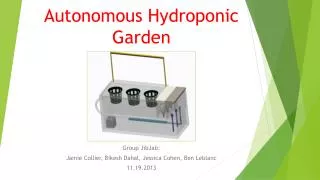
This project presents an automated hydroponic herb garden designed for urban living. Utilizing the Nutrient Film Technique (NFT), it continually supplies nutrients to the plants, ensuring optimal growth and health. Our system automatically monitors pH, electrical conductivity, and temperature, providing a feedback control system for precise nutrient management. The aesthetic design allows it to fit seamlessly into any kitchen. With this hydroponic solution, consumers can easily and cost-effectively grow herbs at home while conserving water and minimizing pest issues.

E N D
An Autonomous Hydroponic Herb Garden Group 6: HYDROPONOMOUS Jessica Cohen Jamie Collier BikeshDahal Ben LeBlanc
Hydroponics Overview • Hydroponics • Method of growing plant using water based mineral solution, without soil. • Benefits: • Requires less water. • Allows for greater control of nutrient levels. • Easier to keep it pest and disease free. • Results in healthier plant growth. • Disadvantages: • Requires more maintenance.
Objective of the Design • General Objectives: • Create a fully automated, counter top, hydroponic herb garden. • Provide consumers with ability to grow herbs in urban living environments easily and cost-effectively. • Aesthetically pleasing exterior design. • Technical Objectives: • Automatically monitor and maintain pH, electrical conductivity and temperature of the nutrient solution. • Feedback control system for nutrients.
Initial Concept and Final Design • Initial Concept: • Ebb and Flow • Grow tray flooded with nutrients and then drained back. • Timer is set to perform the action multiple times a day. • Versatile but vulnerable to power outages, pump, and timer failures. • Final Design: • Nutrient Film Technique (NFT) • Nutrient solution constantly flows past the roots. • Reduced volume of nutrient solution required. • Leading method used for desired plant production.
Ebb-and-Flow vs. NFT Ebb-and-Flow NFT • Pros • Simple fluid dynamics • Great for small-scale • Simple construction • Cons • Water stagnation • Inefficient water use • Only provides moderate level of care • Pros • Commonly used for herbs • Self-stirring • Continuous flow (no timer) • Cons • Continuous power to pump • Maintaining nutrient film a challenge (1L/min) • Overgrown root system may halt flow
Overview of Literature Review • Internet Search: • Most of the existing products are manually operated and lack feedback systems for pH, electrical conductivity, temperature and nutrients. • Few devices have semi automated feedback control systems but are really expensive. ($1,500 or more). • Examples: Super Box, Aero Pro 7, Water Works, Modern Sprout. • Journal Search: • Important to monitor and regulate pH, temperature, and electrical conductivity for better growth of plants.
Control System Arduino is used as the brain of the control system. • pH: • Monitor: pH sensor • Regulate: Administer solution via peristaltic pump • Temperature: • Monitor: Temperature sensor • Regulate: Heater operated by mechanical relay • Electrical Conductivity: • Monitor: EC sensor • Regulate: Administer solution via peristaltic pump
Basic Assumptions for Analysis • Nutrient Solution has same properties as Water • Incompressible • Constant Pressure • Laminar Flow
Head Loss • Head Loss • Total less of head of the fluid throughout a pipe
Evaporation of Water • Pool Equation • Evaporation based on the exposed surface area
Water Usage • Based on evaporation and plant intake
Wall Pressure • Water pressure on wall • Resultant force at 1/3 height
Heating Water • Basic heat transfer equation
Nutrient Solution • Dilution of the nutrient Solution • Conversions • Dosing
Major Purchase Items Total Cost: $321.12
Secondary Purchase Items Total Cost: $82.17
Risks • System not properly waterproofed • Control system not adequately fine tuned • Power outages • Inconsistent nutrient film • Rapid water loss from evaporation • Grow lights will exceed budget