Download
1 / 6
60 likes | 180 Vues
This article delves into American Realism during the Civil War and Post-War period, highlighting the works of Thomas Charles Farrer and others who portrayed real life without the lens of romanticism or idealism. It examines the rejection of sentimentality, the focus on ordinary individuals, and the portrayal of societal issues such as urbanization and political corruption. Key characteristics like verisimilitude, dialect, and ethical dilemmas are discussed, alongside Twain's satirical works, illustrating how realism effectively reflected the complexities of American society.

E N D
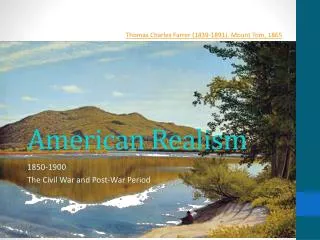
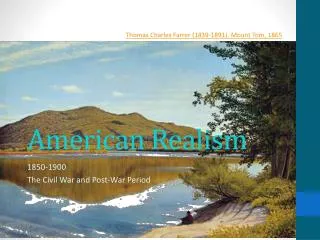
Thomas Charles Farrer (1839-1891), Mount Tom, 1865 American Realism 1850-1900 The Civil War and Post-War Period
Realists sought to accurately portray real life, without filtering it through personal feelings, romanticism, or idealism. Elements of Literature, 6thed (419)
American Realism—Big Ideas • The world is what it is, and that can be awful and frightening • Verisimilitude – present the world as it actually is • accepting reality as reality • rejection of the sensational or sentimental • focus on the ordinary man • loss of optimism
Response to • Start of the Civil War • Rapidly growing cities and slums • Factories replacing farms • Corruption in politics • Sentimentality of Romanticism Children in Mullen’s Alley, photograph, Jacob Riis, 1888
Characteristics • Presents reality in specific detail • Uses language of people and places • Dialect: a variety of language distinguished from other forms of the same language by grammar, spelling, and vocabulary • Vernacular: plain, everyday language used by ordinary people • Character is more important than plot • Ethical dilemmas often explored • Typically focused on the middle class • Avoid the sensational or overly dramatic
Twain’s War Prayer • Read the piece. Make notes about what is happening as you go. • When the mysterious man enters and speaks to the congregation, find examples of irony in his interpretation of their prayer. • What is Twain satirizing here? • What is his message?