Download
1 / 24
240 likes | 364 Vues
This study analyzes archived data from 2005 to evaluate the operational benefits of the System-wide Adaptive Ramp Metering (SWARM) system on OR-217. It compares pre- and post-SWARM implementation data from November 2005, as well as pilot study results from June 2006. The research aimed to validate the SWARM pilot study outcomes, reprocess relevant data, and assess impacts on ramp volumes, travel times, and overall traffic performance. Findings indicate varying outcomes in vehicle hours traveled and ramp inflows under the SWARM system.

E N D
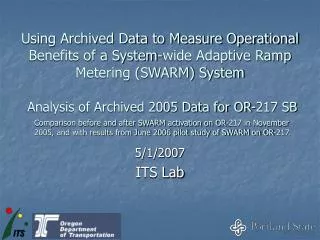
Using Archived Data to Measure Operational Benefits of a System-wide Adaptive Ramp Metering (SWARM) SystemAnalysis of Archived 2005 Data for OR-217 SB Comparison before and after SWARM activation on OR-217 in November 2005, and with results from June 2006 pilot study of SWARM on OR-217. 5/1/2007 ITS Lab
Objectives • Validate OR-217S SWARM pilot study results using 2005 archival data before and after SWARM implementation. • Process 2005 archival data for OR-217S • Loop detector, incident and weather data from PORTAL Archive • Reprocess 2006 pilot data to ensure comparable results. • Incorporate TAC suggestions for data presentation • Ramps and mainline • Ramp volume vs. mainline speed/flow • VHT: Stacked bar comparing mainline and ramp • Travel Time • Break out performance measures by mainline and ramp • Other • Data Quality
Study Periods Pilot Study in June, 2006 • 1 week each pre-timed and SWARM • Pre-Timed: 6/19 – 6/23/06 • Wed 6/21 excluded • SWARM: 6/26 – 6/30/06 • Fri 6/30 excluded Study of 2005 archive data • Before and after SWARM activation on 11/3/2005 • Pre-SWARM: 10/10 – 10/21/05 (2 weeks) • 10/24 – 10/28 (e.g. comm loss ~ 10% on 10/24 & 10/28 @ 72nd) • Post-SWARM: 11/7 – 11/17/05 (2 weeks) • 11/7 – 1 hour comm loss – 10% missing timestamps • Used 11/14 data • 11/21 – 11/25: Thanksgiving
Limitations • Potential sources of variation • Incidents • Depends on accuracy of Portal archived incident data • Climate • Seasonal driving patterns (e.g. school) • Missing data points interpolated within each day. • Greater communications failures than in pilot study • Time period selected to avoid most significant issues • Multi-week study period provides additional data • Can replace one “bad” day with a comparable day
Communications Failures - 2005 • Bottom chart shows problems at isolated ramps on three days pre-SWARM. • Higher percentage of failures in general and system-wide on three particular days post-SWARM.
Communications Failures - 2006 • 72nd Ave excluded from bottom chart • Capacity issues should now be addressed • Data network upgrade in late 2006.
Incidents - 2005 • Highlighted incidents fall within weeks selected for study. • Criteria? • Number of lanes affected, duration (>30 minutes) • 10/11 @ Canyon
Weather Nov 2005 Post-SWARM Oct 2005 Pre-SWARM
Adjustments • Adjusted for incidents, communication loss where most significant. • Pre-Timed • Did not adjust: • 10/11 Walker (Incident) • 10/12 72nd (Comm Loss) • 10/20-21 Walker (Comm Loss) • SWARM • Replaced data for all ramps: • Mon 11/7 with Mon 11/14 • Thu 11/17 with Thu 11/10 • Fri 11/18 with Fri 11/11 • Did not adjust ramp inflow calculations, charts • Also interpolated for missing data points
Performance Measures (6-9/10 AM) • 2006 original analysis was 6-9 am. • 2006 data reprocessed to ensure comparable time range and methods. • 2005 data • Pre-Timed VHT, Delay • Exclusions of incidents could account for shift in numbers • Wednesdays typically bigger travel days than Fridays • Numbers for 2006 data without exclusion of Wed 6/23 and Fri 6/30
VMT • VMT increased by 5.6% from the two weeks studied before SWARM activation and after. • 3.6% between four week periods before and after activation • Possible over-estimation due to communication errors and interpolation. 2005 Pre/Post SWARM June 2006 Pilot
VHT • Higher VHT in 2005 period, especially Tue – Thu • In 2005, VHT lower pre-SWARM than post-SWARM • Versus 2006 pilot study where VHT was lower pre-timed than SWARM 6/06 Pre-timed and SWARM 2005 Pre/Post SWARM
Oscillations 6/06 Pre-timed and SWARM 2005 Pre/Post SWARM
2005 Pre/Post SWARM Ramp Flow – by on-ramp • Flow at each ramp roughly comparable between 2005 and 2006. • 2005: slight decrease under SWARM • 2006: slight increase under SWARM • Note: 2006 chart does not include Greenburg, 99W, and 72nd June 2006 Pilot
Ramp Volume - Oblique • Higher on-ramp inflows during 2005 pre-SWARM period than 2005 post-SWARM or 2006 pilot • Change in behavior? • Do specific ramps account for the increase? • Implies that in 2005, SWARM was more restrictive than pre-timed from 7:30 to 8:30 am • Under SWARM ramp inflows roughly comparable between 2005 and 2006 • Slightly higher during June 2006 pilot 2005 Pre/Post SWARM June 2006 Pilot • Note: Greenburg, 72nd, and 99W are not included in 2005 chart, since they were not included in the 2006 pilot study.
Metering Activation by Ramp, 2006 June 2006 Pilot: BH Hwy June 2006 Pilot: Scholl’s Ferry • Reduced metering window under SWARM • Work in progress – show mainline
Delay – by ramp • High pre-SWARM delay for many ramps in 2005 • Particularly BH Hwy, Scholl’s, and Greenburg • Based on 2005 data, SWARM reduced delay at many ramps • But contradicts 2006 pilot study 6/06 Pre-timed and SWARM 2005 Pre/Post SWARM
Delay – by day of week • High pre-SWARM delay for many ramps in 2005 • Tue, Wed, Thu > Mon > Fri 2005 Pre/Post SWARM 6/06 Pre-timed and SWARM
Combined presentation of previous two slides Focus on BH Hwy, Scholl’s, and Greenburg Delay – 2005By Ramp and Day of Week
On-Ramp Travel Times • Not in scope of analysis of 2005 data • Travel times for BH Hwy and Scholls Ferry on-ramps • SWARM, June 2006, 23% lower at BH Hwy and 37% lower at Scholl’s Ferry • 5 minute samples from video, 6-19-06 to 6-29-06 June 2006 Pilot: BH Hwy June 2006 Pilot: Scholl’s Ferry FIGURE 9(a) Travel time on the Beaverton-Hillsdale Highway on-ramp. FIGURE 9(b) Travel time on the Scholls-Ferry Rd. on-ramp.
Summary of Findings • Increase in pre-timed VHT, Delay in 2005 vs. 2006 pilot study • ??? • Additional weeks allowed bad data to be replaced • Some effect but not a major change
Work in Progress • TAC Suggestions – Plan to incorporate as many as possible by next meeting • On ramp volume vs. mainline speed and flow • Comparison of travel time change on mainline and ramp • Comparison of VHT on ramp and mainline • Delay by time • Break up performance measures by ramp and mainline