
NAT and NAT Traversal
E N D
Presentation Transcript
NAT and NAT Traversal SEng490 Directed Study Haoran Song Supervised by Dr. Jianping Pan
Outline • Problems of NAT in the real world • NAT Traversal in our research • Conclusion
Four Types of NAT • Full Cone NAT • IP Restricted NAT • Port Restricted NAT • Symmetric NAT Then let us see how these four NATs work?
IP Restricted NAT • Has restrictions on incoming IP
Port Restricted NAT • Not only has restrictions on IP, but also on Port
Symmetric NAT • Very restricted. New mapping for each different connection.
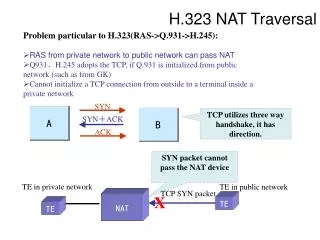
Problems caused by NAT • So, When we do communication with NAT, outside packets can not come in until inside packets go out first. • We need to find a way to overcome this problem and this technique is called NAT Traversal.
NAT Traversal • Our plan • We need to know what NAT we are behind • Do NAT traversal according to the identified NAT • Therefore, two main parts in our research • NAT Detection • NAT Traversal
NAT Detection We get the PolyNAT from Dr. Hoffman. It can emulates four different NATs. Thanks to Dr. Hoffman and his students.
NAT Traversal • NAT Traversal B cone IP restricted port restricted symmetric A cone IP restricted port restricted ? symmetric ?
How does clients describe who they are • We build our own traversal commands • We use XML to describe necessary information and embed these descriptions in our traversal commands. • So, other clients get specified information about their peers by learning these XML contents.
Conclusion • We have implemented • Full Cone – Full Cone • Full/Restricted Cone – Restricted Cone • Full/IP Restricted Cone – Symmetric • The things we will do in the future • Port Restricted Cone – Symmetric • Symmetric – Symmetric
NAT and NAT Traversal • Questions?