Download
1 / 11
110 likes | 227 Vues
This document outlines the curriculum for Unit 3 of the Chemistry course, focusing on two main areas of study: Chemical Analysis and Organic Chemical Pathways. Each area will take a term to cover, with relevant assessments including three S.A.C.s (School-Assessed Coursework) culminating in an exam on June 10th. The exam consists of 20 multiple-choice and approximately 8 short-answer questions. Key concepts such as significant figures, qualitative vs. quantitative analysis, and empirical/molecular formulas are emphasized, along with practical investigation of lawn fertilizer composition.

E N D
Analysis by Mass Chapter 2
Unit 3 • Consists of Area of Study 1 • Chemical analysis • Area of Study 2 • Organic Chemical Pathways • Each area of study will take about a term • Though hopefully quicker • There are 3 sacs and 1 exam a semester
The Exam • This is what you are working towards. • The chemistry unit 3 exam is on June 10th • It consists of 15 minutes reading time and 1.5 hours writing time. • It is made up of 20 multiple choice questions and about 8 short answer questions • You get a data booklet and are allowed a scientific calculator (no graphics)
The S.A.C.s • There are 3 S.A.C.s in unit 3 • The first one is in Area of Study 1 • This is the extended experimental investigation (E.E.I.) • This will begin in week 6 (Mar 9) and will take about 3 weeks. • It consists of 3 practical activities, questions to be answered on each prac, risk assessments to be written for each prac, a report to be written on all 3 pracs. • The E.E.I. will be on the analysis of the composition of lawn fertiliser
The S.A.C.s • The next two S.A.C.s will be in area of study 2. • One will be a practical report • One will be a response to written stimulus
Significant Figures • All your answers to calculations this year must be to significant figures. • Look at page 470 (Appendix 1) • A zero that comes before integers in not significant but a zero that comes after an integer is. • Significant figures is where your final value you calculate is only as precise as your least precise piece of data. • Meaning your answer has to use the lowest amount of significant figures that the question contains.
Final mass of sample x 100 Initial mass of sample So lets review the holiday homework • What is the difference between qualitiative and quantitative analysis? • What are some analysis techniques and why might we use them? • Look at page 12 worked example and answer question 1 on page 12. • Remember % by mass is: • Do questions 3 and 5 page 12
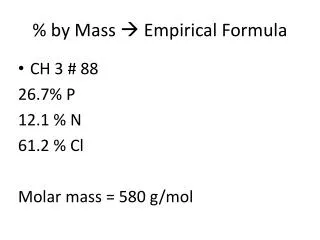
Empirical Formula Step 1: Measure the mass (m) of each element in the compound • Simplest whole number ratio of the atoms present in the compound Step 2: Calculate the amount in mole (n) of each element in the compound Step 3: Calculate the simplest whole number ratio of moles of each element in the compound Step 4: Determine the empirical formula of the compound
molar mass of compound = molar mass of one unit Molecular Formula • Gives the actual number of atoms of each element present in a molecule of compound • One unit can be the empirical formula molecular mass
Stoichiometry • What equations do we know?? • Page 21 • Lets do question 21 together.
Homework • P.12 Q 1, 3, 5 • P.25 Q 21, 25, 27, 29, 31 • P. 26 Q 36, 41, 42, 44