Effective Time Management Strategies for Enhanced Productivity and Work-Life Balance
This training session led by Julie Stewart, Sales Training Manager, aims to improve time management skills by introducing five key categories: goal setting, prioritization, managing interruptions, procrastination, and scheduling. Participants will engage with survey results and learn about two essential tools for managing time effectively. The session emphasizes working smarter rather than harder, maximizing personal and professional priorities, and utilizing technology to enhance productivity. Join us for insights into achieving a better balance in your daily schedule.

Effective Time Management Strategies for Enhanced Productivity and Work-Life Balance
E N D
Presentation Transcript
Time managementfor aums Julie Stewart Sales Training Manager FOR TRAINING PURPOSES ONLY. Material adapted from Mind Tools 2012
Let’s face it … We’d all love to have an extra couple of hours in ourday. Since that’s impossible, we need to work smarter on things that have the highest priority, and then create a schedule that reflects our work and personal priorities. FOR TRAINING PURPOSES ONLY. Material adapted from Mind Tools 2012
Session Goals • Introduce five categories of time management • Discuss survey results • Share two tools for managing time • There’s an app for that FOR TRAINING PURPOSES ONLY. Material adapted from Mind Tools 2012
Five key areas • Goal setting • Prioritization • Managing interruptions • Procrastination • Scheduling FOR TRAINING PURPOSES ONLY. Material adapted from Mind Tools 2012
The SurveyHow we look as a team FOR TRAINING PURPOSES ONLY. Material adapted from Mind Tools 2012
The SurveyHow we look as a team FOR TRAINING PURPOSES ONLY. Material adapted from Mind Tools 2012
Our group ‘ofi’ • Goal setting • Prioritization • Managing interruptions • Procrastination • Scheduling FOR TRAINING PURPOSES ONLY. Material adapted from Mind Tools 2012
The matrix FOR TRAINING PURPOSES ONLY. Material adapted from Mind Tools 2012
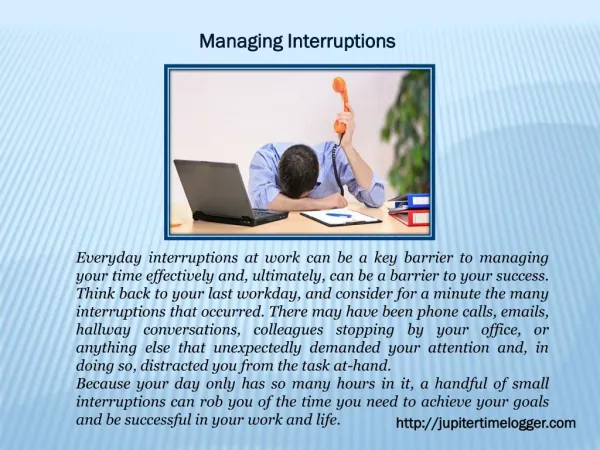
The matrix The key to controlling interruptions is knowing what they are, whether they are necessary, and planning for them in your daily schedule. FOR TRAINING PURPOSES ONLY. Material adapted from Mind Tools 2012
Who? When? What? FOR TRAINING PURPOSES ONLY. Material adapted from Mind Tools 2012
And … how? • Analyze and conquer • Put your phone to work for you • Create ‘available’ and ‘unavailable’ time • Schedule regular check-ins • Uncontrollable interruptions • Set time parameters • Don’t invite the interrupter to sit • Get to the point • Reschedule if exceeding time limit FOR TRAINING PURPOSES ONLY. Material adapted from Mind Tools 2012
There’s an app for that FOR TRAINING PURPOSES ONLY. Material adapted from Mind Tools 2012
Thank you • Questions? • Feel free to contact: • Julie Stewart • jastewart@torchmarkcorp.com • 469-525-4207 FOR TRAINING PURPOSES ONLY. Material adapted from Mind Tools 2012