Projectile Motion: Speed
80 likes | 213 Vues
This resource presents a comprehensive overview of projectile motion through the example of an artillery shell launched from a mountain fortress. It details the vertical speed, initial conditions (including the muzzle velocity and cannon height), and relevant equations governing the shell’s trajectory. The analysis incorporates the effects of gravitational acceleration and provides equations to calculate the shell's height and vertical velocity over time. This serves as a practical demonstration for students in the Department of Electrical and Computer Engineering at UTEP.


Projectile Motion: Speed
E N D
Presentation Transcript
Projectile Motion:Speed Scott Starks, PhD, PE Dept. of Electrical & Computer Engineering UTEP Projectile Motion
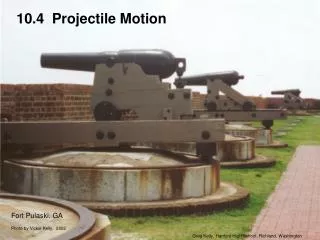
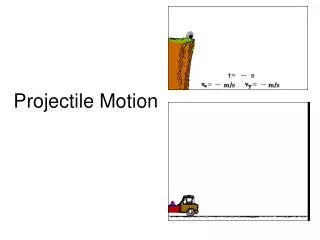
Example: Artillery Shell • At time t=0, an artillery shell is launched with a vertical speed of v0 from atop a fortress that is situated atop a mountain of height y0. y0 Projectile Motion
Equation of Motion (Vertical) • y is the height (ft) of the projectile above the ground at time t (s) • g is the acceleration constant (32 ft/s2) • v0 is the muzzle (initial) velocity (ft/s) • y0 is the height of the cannon above ground (ft) • Note: We are only considering vertical height in this example. Projectile Motion
Initial Conditions • Assume the cannon is located 672 ft above ground level. • Assume the muzzle velocity is 656 ft/s. Projectile Motion
Incorporate Initial Conditions in Equation of Motion Projectile Motion
Height of the Projectile (y) t (s) Table Plot Projectile Motion
Vertical Velocity (Speed) of the Projectile • The vertical speed (v) of the projectile measured in (ft/s) at time (t) is described by the equation Projectile Motion
Vertical Velocity (Speed) of the Projectile t (s) Table Plot Projectile Motion