Understanding Continuity and Discontinuity in Functions
This section explores the concepts of continuity and discontinuity in functions, detailing the conditions under which a function f(x) is continuous at a point x = c. It describes various types of discontinuities, including removable, infinite, and jump discontinuities, and provides examples to clarify these concepts. The discussion highlights important terms such as right-continuous and left-continuous, and offers insight into determining values that can render a function continuous. Understanding these principles is crucial for analyzing the behavior of functions in mathematics.

Understanding Continuity and Discontinuity in Functions
E N D
Presentation Transcript
Section 2.8 - Continuity I can determine where functions are continuous and discontinuous 2.2
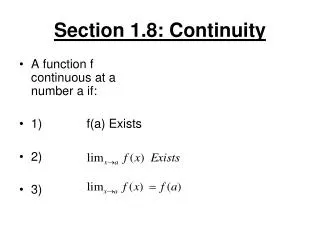
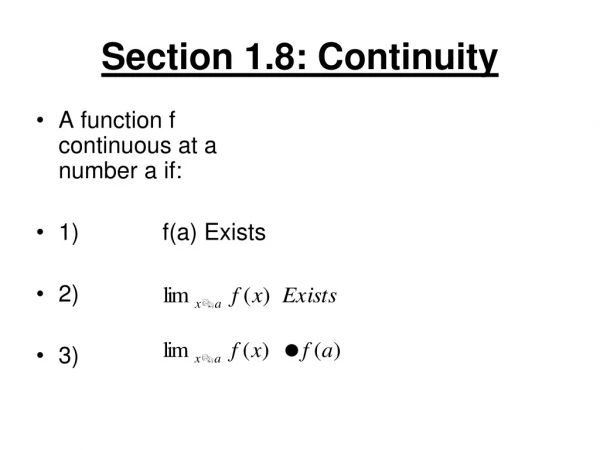
Vocab Continuous: A function f(x) is continuous at x = c if and only if all three of the following tests hold: Discontinuous: holes, vertical asymptotes, jumps in the graph Right continuous: Left continuous: Point (Removable) Discontinuity: hole in the graph, which can be removed if you redefine the hole Infinite Discontinuity: vertical asymptote exists Jump Discontinuity: The graph jumps which allows the limit to not exist.
Example of Removable Discontinuity Point Discontinuity: Can be removed if we add a point:
A function f(x) is continuous at x = c if and only if all three of the following tests hold: f(x) is right continuous at x = -5 f(x) is continuous at x = -4 f(x) has infinite discontinuity at x = -3[i, iii] f(x) has point discontinuity at x = -2 [i, iii] f(x) has infinite discontinuity at x = -1[i, ii, iii] f(x) is continuous at x = 0
At x = 1 At x = 2 At x = 3 At x = 4 At x = 5 Point Discontinuity [i, iii] Jump Discontinuity [i, ii, iii] Continuous Continuous Point Discontinuity [i, (ii), iii]
continuous continuous pt. discontinuity at x = 0 inf. discontinuity at x = 1 pt. discontinuity at x = 3 continuous inf. discontinuity at x = -3 jump discontinuity at x = 2
Find the value of a which makes the function below continuous
Consider the function Find the value of k which makes f(x) continuous at x = 0 , if k =1, the hole is filled. Since