A Theoretical Framework for Hedonic Office Studies: Understanding User Accommodation Preferences
120 likes | 249 Vues
This research explores the accommodation preferences of office users within the context of a buyers' market. It critically reviews hedonic office rent studies from the 1980s and provides a theoretical underpinning for interpreting various influencing variables. The study employs a modeling approach utilizing hedonic analysis and addresses statistical challenges, including multicollinearity and spatial autocorrelation. Results indicate significant variables impacting office rent, including building characteristics and age. This framework serves as a foundation for future exploration of user preferences in office space.


A Theoretical Framework for Hedonic Office Studies: Understanding User Accommodation Preferences
E N D
Presentation Transcript
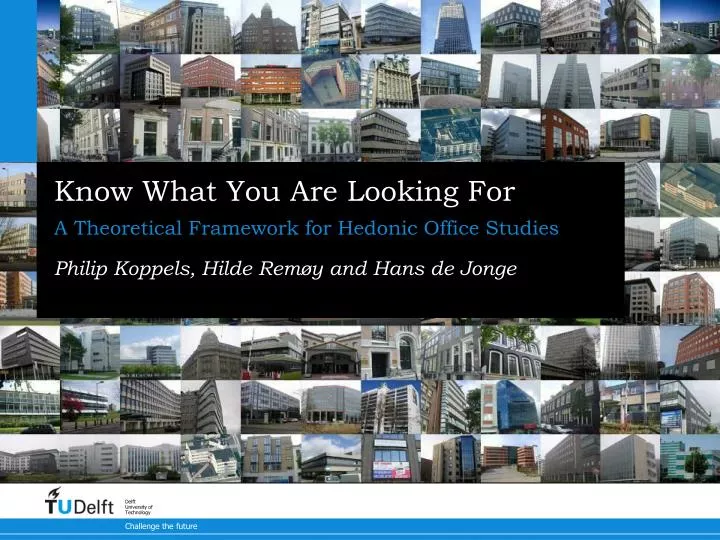
Know What You Are Looking For A Theoretical Framework for Hedonic Office Studies Philip Koppels, Hilde Remøy and Hans de Jonge
Introduction Accommodation Preferences of Office Users • Buyers market conditions; what do office users prefer? • Hedonic office rent studies since the 1980’s • Theoretical underpinning; interpretation of variables • Statistical issues; multicollinearity, unequal variance, …. • Structure of the presentation: • Research introduction • Modeling approach • Hedonic analysis • Interpretation of results
Modelling Approach Number of observations; Thin markets Longer time series or larger research area Multiple correlated transactions in one building; repeated measurements? Two level hierarchical model: Level one; transaction Level two; the building Other issues: Unbalanced panel data, unequal spaced observations Spatial autocorrelation A Linear Mixed Model
Basic Location Adjusted Model • Model fit statistics: • BIC first model: -659.4 • BIC second model: -784.7
Final Results Random building intercept; significant Random age coefficient; significant Covariance building intercept and age coefficient; negative Range spatial correlation: 550 meters Covariance Parameters
Final Results Fixed Effects
Final Results Fixed Effects
Questions? Contact author: p.w.koppels@tudelft.nl