SSE3 Hypertext concepts
This comprehensive overview delves into the evolution of hypermedia technology, exploring foundational concepts and the historical contributions of pioneers like Vannevar Bush and Douglas Engelbart. It discusses the role of hypertext as a memory extender and problem solver while examining various structuring mechanisms, including spatial and classification approaches. The challenges and advantages of open hypermedia systems are outlined, alongside the architecture of client-server systems. The project emphasizes knowledge management, enabling the organization, reuse, and sharing of knowledge in collaborative environments.

SSE3 Hypertext concepts
E N D
Presentation Transcript
SSE3 Hypertext concepts Jens Bjarke Pedersen
Agenda • Pioneers and evolution • Hypermedia • Modern hypermedia technology • Structure domains • Architectural evolution • The project
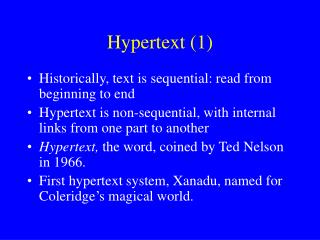
Pioneers and history • Vannevar Bush – Memex • Hypertext as memory extender • Douglas C. Engelbart • Cooperative view: Hypertext as problem solver • NLS=Online system, traveling through working files • Theodor Holm Nelson • Communication view: Hypertext as linked text base • Text was never to be deleted • Adapted to WWW
Hypermedia • What is hypertext/media • WWW • Documents • Links and anchors • Associate structures • Tendency to Navigational only • People structure knowledge in many ways • Spatial, classification, issue, annotation
Hypermedia • Modern Hypermedia technology • Multiple structuring mechanism in one system • Provided for one document • Provide structure in existing applications • If not possible the app wont be used • State of the art software technology • Open systems • Flexible architecture • Well defined interfaces • Development tools
Hypermedia • Separation of documents and structure unlike the WWW • Structure can be add to all types of documents and stored elsewhere • Allows for multiple structures • Associations • Classification • Argumentation support • Spatial organization • Metadata • Annotations
Architectural evolution • Client-Server system
Architectural evolution Open hypermedia systems • OHS offer open link services • Link server system (LSS): provides hypertext structuring facilities to an open set of applications • Hyperbase management system (HBMS): like LSS, but also includes hypertext storages facilities
Architectural evolution • Advantages • Well-defined open interfaces • Open client layer: 3rd party applications are able to access the link service • Separate backend and middleware layer: different contexts can be implemented easily • Disadvantages • Increased system complexity • Standardized communication protocols? • Problems • Different hypermedia services • Different data models (e.g. different link types) • Different hypermedia architectures • Results • Applications can only use certain OHS • Hypermedia structure only useable for certain storage architectures • Hypermedia structures cannot be extended beyond the system (island problem)
Architectural evolution Component based OHS • Client layer • Client interface • Structure service layer • Structure service API • Backend API • Backend layer
The project Motivation: • Current work flow(Field study of ourselves) • Split into three phases 12
The project Overview: • Knowledge management system • Reusing existing knowledge, Organize knowledge in projects, sharing knowledge
The project Overview: • Hypertext concepts • Links, anchors, different structures of information
The project Overview • Computer supported cooperative work • Planning, Shared information space, asynchronous cooperation on documents
The project • Architecture
The project • New work flow With the use of the system