Understanding Probability and Odds Vocabulary for Success in Statistics
This resource provides essential vocabulary related to probability and odds that students should memorize for better understanding and success in statistics. Key terms include outcome, event, sample space, and the distinctions between theoretical and experimental probability. The explanations are accompanied by examples, such as rolling a die or flipping coins, to illustrate concepts clearly. Understanding these terms will help students analyze probability scenarios effectively and find odds related to various outcomes.

Understanding Probability and Odds Vocabulary for Success in Statistics
E N D
Presentation Transcript
Vocabulary you should memorize: • outcome: a possible result of an experiment • event: a specific outcome or collection of outcomes • sample space: the collection of all possible outcomes • Example: When rolling a 6-sided die, you want to roll an odd number. • One outcome is to roll a 5. The event would consist of rolling a 1, 3, or 5. The sample space would be 1, 2, 3, 4, 5, and 6.
How to find a sample space: One option is “brute force,” meaning to make a list and exhaust all options. You flip 3 coins. What is the sample space?
Making a Tree Diagram: You flip a coin and roll a number cube. How many outcomes are in the sample space? List all possible outcomes.
You flip 2 coins and roll a number cube. How many outcomes are in the sample space? List the possible outcomes.
probability: a number from 0 to 1 used to measure of the likelihood, or chance, that an event will occur. -can be expressed as a decimal, fraction, or percent
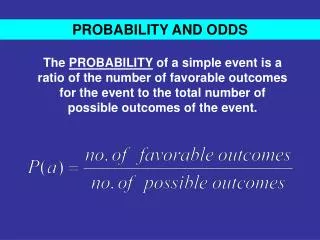
Two different types of probability: theoretical probability: number of favorable outcomes number of all possible outcomes The “probability of A” can be written P(A).
experimental probability: based on repeated trials of an experiment. number of successes number of trials
odds: compare the number of favorable and unfavorable outcomes when all outcomes are equally likely. odds in favor = # favorable outcomes # unfavorable outcomes odds against = #unfavorable outcomes # favorable outcomes
Assuming that all colors are equally likely, find the odds for and the odds against landing on green.
Assignment: pg. 846 #3 – 16 all, 19, 20