Download
1 / 11
110 likes | 234 Vues
Explore the fascinating realm of animal behavior, focusing on how animals react to different stimuli. Learn about innate behaviors, instinct vs. learned responses, and various types of learning such as habituation, classical conditioning, and operant conditioning. Discover the significance of social behavior, imprinting in newborns, and how environmental changes influence migration and hibernation patterns. This comprehensive overview will deepen your understanding of the complexities in animal behavior and the factors that shape their actions.

E N D
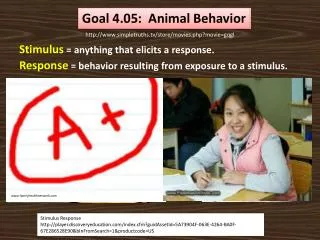
Goal 4.05: Animal Behavior http://www.simpletruths.tv/store/movies.php?movie=gqgl Stimulus = anything that elicits a response. Response = behavior resulting from exposure to a stimulus. z.about.com www.betaversion.org img2.timeinc.net bottledsky.com www.familyhealthnetwork.com 3.bp.blogspot.com hiphappy.files.wordpress.com Stimulus Response http://player.discoveryeducation.com/index.cfm?guidAssetId=5A73904F-063E-4264-BA0F-67E286528E90&blnFromSearch=1&productcode=US
Innate (instinctive) Behavior = born with it/inherited visionsofspring.org INSTINCT vs. LEARNED http://player.discoveryeducation.com/index.cfm?guidAssetId=24A908BF-B21C-432C-8647-C3040AFA498F&blnFromSearch=1&productcode=US
Instinct = behaviors that an organism is born knowing. Innate = referring to instinctive behaviors. www.touchstonefarm.org www.ruralni.gov.uk www.zimfamilycockers.com www.biocrawler.com Animal Instincts http://player.discoveryeducation.com/index.cfm?guidAssetId=3B2D0821-9886-4BA6-9C40-26DFB11AB1B3&blnFromSearch=1&productcode=US
Learned Behavior = resulting from experience Habituation: animals stops responding to a stimulus to which it repeatedly exposed. Classical Conditioning: animal makes a mental connection between a stimulus and reward/punishment. (Pavlov’s Dog Experiments) Operant Conditioning: (trial and error) animal learns to repeat behaviors that result in rewards and avoid behaviors that result in punishment. Learned Behaviors http://videos.howstuffworks.com/hsw/11476-animal-intelligence-learned-response-video.htm
Learned Behavior = resulting from experience Insight Learning: animal applies what it has already learned to a new situation.
Social Behavior = behavior resulting from interactions with others. Horse dominance http://videos.howstuffworks.com/hsw/22314-adapting-to-deserts-the-dominant-male-kathys-herd-video.htm
Imprinting = learning based on early experience Usually learned immediately or very soon following birth. Some newborn animals will imprint on the first thing they see move following birth. Others imprint on a location. Example: Spawning salmon return to their hatching grounds to breed. kentsimmons.uwinnipeg.ca terrallectualism.files.wordpress.com www.sundancestablesfl.com www.psywww.com naturescrusaders.files.wordpress.com www.awakeningpotentials.com
Circadian Rhythm = cycle that happens daily www.dietsinreview.com www.qfac.com www.moonbattery.com
neatorama.cachefly.net Migration = movement from one location to another based on seasonal changes Sooty Shearwater – longest migration Sea Turtle migration routes Snow goose migration www.ontfin.com ih1.redbubble.net www.qc.ec.gc.ca www.wildlifeextra.com www.bahiamap.com africansafaris.co.ke
Estivation vs. Hibernation Hibernation = sleeping during winter months ladybugs squirrels hedgehogs bears bats www.pwcs.edu ladybuglady.com www.bear.org jerseyhedgehogs.co.uk www.daviddarling.info
Estivation vs. Hibernation Estivation = sleeping during summer months as a survival mechanism against environmental events such as heat, drought, etc. Very common in desert animals. Beaded lizard Spade foot toad Jersey tiger moths snails z.about.com open.live.bbc.co.uk http-server.carleton.ca absoluteastronomy.com