Advances in Matrix Analytic Techniques for Queuing Models: The ETAQA Methodology
This seminar discusses the development of matrix analytic techniques for analyzing queuing models, particularly focusing on general distributions. Presenting a novel methodology, ETAQA, the talk delineates how this method utilizes known results from Markov chains to efficiently address queuing systems subject to varied interarrival and service time distributions. It highlights the effectiveness of ETAQA in providing exact and numerically stable solutions, and showcases its application in evaluating load balancing policies for clustered web servers. Ongoing research projects will also be discussed.

Advances in Matrix Analytic Techniques for Queuing Models: The ETAQA Methodology
E N D
Presentation Transcript
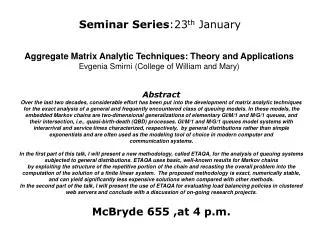
Aggregate Matrix Analytic Techniques: Theory and ApplicationsEvgenia Smirni (College of William and Mary) Seminar Series:23th January Abstract Over the last two decades, considerable effort has been put into the development of matrix analytic techniques for the exact analysis of a general and frequently encountered class of queuing models. In these models, the embedded Markov chains are two-dimensional generalizations of elementary GI/M/1 and M/G/1 queues, and their intersection, i.e., quasi-birth-death (QBD) processes. GI/M/1 and M/G/1 queues model systems with interarrival and service times characterized, respectively, by general distributions rather than simple exponentials and are often used as the modeling tool of choice in modern computer and communication systems. In the first part of this talk, I will present a new methodology, called ETAQA, for the analysis of queuing systems subjected to general distributions. ETAQA uses basic, well-known results for Markov chains by exploiting the structure of the repetitive portion of the chain and recasting the overall problem into the computation of the solution of a finite linear system. The proposed methodology is exact, numerically stable, and can yield significantly less expensive solutions when compared with other methods. In the second part of the talk, I will present the use of ETAQA for evaluating load balancing policies in clustered web servers and conclude with a discussion of on-going research projects. McBryde 655 ,at 4 p.m.