A Simple, Scientific Way to Optimize Catalyst Preparation
30 likes | 179 Vues
This research, led by John R. Regalbuto at the Dept. of Chemical Engineering, explores a novel and fundamental method for optimizing catalyst preparation. By leveraging strong electrostatic adsorption mechanisms, this method identifies the optimal pH for effective metal coordination, leading to the generation of extremely small nanocrystals. These advancements not only enhance the efficiency of metal utilization in fuel cells and catalytic converters but also provide a more cost-effective approach to catalyst production, facilitating broader applications in environmental cleanup, chemical synthesis, and energy production.


A Simple, Scientific Way to Optimize Catalyst Preparation
E N D
Presentation Transcript
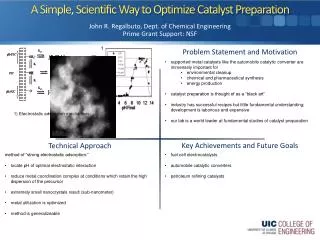
A Simple, Scientific Way to Optimize Catalyst Preparation John R. Regalbuto, Dept. of Chemical Engineering Prime Grant Support: NSF • supported metal catalysts like the automobile catalytic converter are immensely important for • environmental cleanup • chemical and pharmaceutical synthesis • energy production • catalyst preparation is thought of as a “black art” • industry has successful recipes but little fundamental understanding; development is laborious and expensive • our lab is a world leader at fundamental studies of catalyst preparation 1) Electrostatic adsorption mechanism • method of “strong electrostatic adsorption:” • locate pH of optimal electrostatic interaction • reduce metal coordination complex at conditions which retain the high dispersion of the precursor • extremely small nanocrystals result (sub-nanometer) • metal utilization is optimized • method is generalizeable • fuel cell electrocatalysts • automobile catalytic converters • petroleum refining catalysts