Download
1 / 7
90 likes | 99 Vues
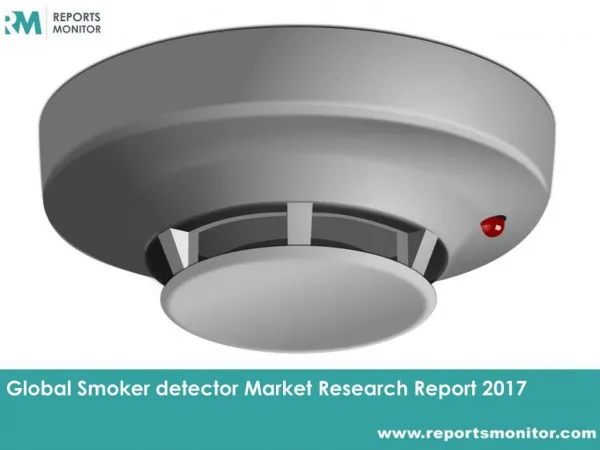
An innovative new tester for the functional testing of smoke detectors. Solo 365 delivers smoke via Solo ES3 smoke cartridges offering faster, simpler and cleaner testing. Visit Us: https://www.novus.ae/smoke-detector-testers/<br><br><br>

E N D
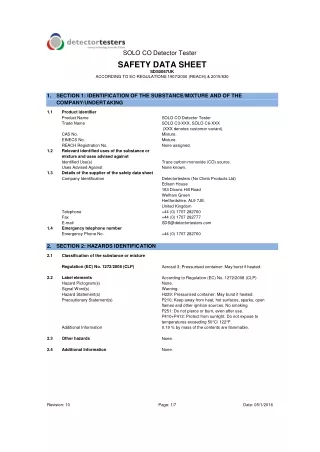
SOLO CO Detector Tester SAFETY DATA SHEET SDS0067UK ACCORDING TO EC-REGULATIONS 1907/2006 (REACH) & 2015/830 1. SECTION 1: IDENTIFICATION OF THE SUBSTANCE/MIXTURE AND OF THE COMPANY/UNDERTAKING 1.1 Product identifier Product Name Trade Name SOLO CO Detector Tester SOLO C3-XXX, SOLO C6-XXX (XXX denotes customer variant). Mixture. Mixture. None assigned. 1.2 CAS No. EINECS No. REACH Registration No. Relevant identified uses of the substance or mixture and uses advised against Identified Use(s) Uses Advised Against Details of the supplier of the safety data sheet Company Identification 1.3 Trace carbon monoxide (CO) source. None known. Detectortesters (No Climb Products Ltd) Edison House 163 Dixons Hill Road Welham Green Hertfordshire. AL9 7JE. United Kingdom +44 (0) 1707 282760 +44 (0) 1707 282777 SDS@detectortesters.com +44 (0) 1707 282760 1.4 Telephone Fax E-mail Emergency telephone number Emergency Phone No. 2. SECTION 2: HAZARDS IDENTIFICATION 2.1 2.2 Classification of the substance or mixture Regulation (EC) No. 1272/2008 (CLP) Label elements Hazard Pictogram(s) Signal Word(s) Hazard Statement(s) Precautionary Statement(s) Aerosol 3; Pressurised container: May burst if heated. According to Regulation (EC) No. 1272/2008 (CLP) None. Warning. H229: Pressurised container: May burst if heated. P210: Keep away from heat, hot surfaces, sparks, open flames and other ignition sources. No smoking. P251: Do not pierce or burn, even after use. P410+P412: Protect from sunlight. Do not expose to temperatures exceeding 50°C/ 122°F. 0.19 % by mass of the contents are flammable. None. None. Additional Information 2.3 2.4 Other hazards Additional Information Revision: 10 Page: 1/7 Date: 05/1/2016
SOLO CO Detector Tester 3. SECTION 3: COMPOSITION/INFORMATION ON INGREDIENTS Product as supplied: Aerosol. 3.1 Mixtures EC Classification No. 1272/2008 Hazardous Ingredient(s) Carbon monoxide %W/W CAS No. EC No. REACH Hazard Pictogram(s) and Hazard Statement(s) GHS02, Flam. Gas 1; H220 GHS04, Press. Gas; H280 GHS06, Acute Tox. 3; H331 GHS08, Repr. 1A; H360D, STOT RE 1; H372 Registration No. None assigned <1 630-08-0 211-128-3 3.2 Additional Information For full text of H/P statements see section 16. 4. SECTION 4: FIRST AID MEASURES 4.1 Description of first aid measures Inhalation If breathing is difficult, remove victim to fresh air and keep at rest in a position comfortable for breathing. Wash skin with soap and water. Flush eyes with water for at least 15 minutes while holding eyelids open. Unlikely route of exposure. None anticipated. Skin Contact Eye Contact 4.2 Ingestion Most important symptoms and effects, both acute and delayed Indication of any immediate medical attention and special treatment needed 4.3 Unlikely to be required but if necessary treat symptomatically. 5. SECTION 5: FIREFIGHTING MEASURES Pressurised container: May burst if heated. 5.1 Extinguishing media Suitable Extinguishing media Unsuitable extinguishing media 5.2 Special hazards arising from the substance or mixture 5.3 Advice for fire-fighters Extinguish with waterspray. None known. Heating may cause pressure rise with risk of bursting. Fire fighters should wear complete protective clothing including self-contained breathing apparatus. If it is safe to do so, containers should be removed from fire area because they are likely to rupture under fire conditions. 6. SECTION 6: ACCIDENTAL RELEASE MEASURES The product is an aerosol. It is unlikely to present spillage or leakage hazard. 6.1 Personal precautions, protective equipment and emergency procedures 6.2 Ensure adequate ventilation. Environmental precautions No special measures are required. Revision: 10 Page: 2/7 Date: 05/1/2016
SOLO CO Detector Tester Collect mechanically and dispose of according to Section 13. Containers must not be punctured or destroyed by burning, even when empty. See Also Section: 8, 13. 6.3 Methods and material for containment and cleaning up 6.4 Reference to other sections 7. SECTION 7: HANDLING AND STORAGE 7.1 Precautions for safe handling Keep away from heat, hot surfaces, sparks, open flames and other ignition sources. No smoking. Do not pierce or burn, even after use. Provide adequate ventilation. Observe official regulations on storing packagings with pressurised containers. Pressurized container: protect from sunlight and do not expose to temperatures exceeding 50 °C. Stable under normal conditions. None anticipated. Trace carbon monoxide (CO) source. 7.2 Conditions for safe storage, including any incompatibilities Storage temperature 7.3 Storage life Incompatible materials Specific end use(s) 8. SECTION 8: EXPOSURE CONTROLS/PERSONAL PROTECTION 8.1 8.1.1 Control parameters Occupational Exposure Limits SUBSTANCE CAS No. LTEL (8 hr TWA ppm) 30 LTEL (8 hr TWA mg/m³) 35 STEL (ppm) 200 STEL (mg/m³) 232 Note Carbon monoxide 630-08-0 WEL WEL: Workplace Exposure Limit (UK HSE EH40) 8.1.2 Biological limit value Not established. 8.1.3 PNECs and DNELs Not established. 8.2 8.2.1 8.2.2 Exposure controls Appropriate engineering controls Personal protection equipment Eye/ face protection Provide adequate ventilation. Not normally required. Skin protection (Hand protection/ Other) Not normally required. Respiratory protection No personal respiratory protective equipment normally required. Handling of larger amounts: In case of insufficient ventilation, wear suitable respiratory equipment. A suitable mask with filter type A (EN14387 or EN405) may be appropriate. Not applicable. No special measures are required. Thermal hazards Environmental Exposure Controls 8.2.3 Revision: 10 Page: 3/7 Date: 05/1/2016
SOLO CO Detector Tester 9. SECTION 9: PHYSICAL AND CHEMICAL PROPERTIES 9.1 Information on basic physical and chemical properties Appearance Colour Odour Odour threshold pH Melting point/freezing point Initial boiling point and boiling range Flash Point Evaporation rate Flammability (solid, gas) Upper/lower flammability or explosive limits Vapour pressure Vapour density Relative density Solubility(ies) Partition coefficient: n-octanol/water Auto-ignition temperature Decomposition Temperature Dynamic viscosity Kinematic Viscosity Explosive properties Aerosol. Colourless. None. Not applicable. Not determined. Not determined. Not available. Not available. Not applicable. Non-flammable. Not determined. Not determined. Not determined. Heavier than air. Not determined. Not determined. Not determined. Not determined. Not determined. Not determined. Not explosive. Pressurised container: May burst if heated. Not oxidising. None. 9.2 Oxidising properties Other information 10. SECTION 10: STABILITY AND REACTIVITY 10.1 10.2 10.3 Stability and reactivity Chemical stability Possibility of hazardous reactions Stable under normal conditions. Stable under normal conditions. No hazardous reactions known if used for its intended purpose. Heat and direct sunlight. None anticipated. No hazardous decomposition products known. 10.4 10.5 10.6 Conditions to avoid Incompatible materials Hazardous decomposition product(s) 11. SECTION 11: TOXICOLOGICAL INFORMATION Information on toxicological effects Acute toxicity Skin corrosion/irritation Serious eye damage/irritation Respiratory or skin sensitization Germ cell mutagenicity Carcinogenicity Reproductive toxicity STOT - single exposure STOT - repeated exposure Aspiration hazard Other information 11.1 11.2 Low acute toxicity. Non-irritant. Not classified. It is not a skin sensitiser. There is no evidence of mutagenic potential. No evidence of carcinogenicity. None anticipated. Not classified. Not classified. None anticipated. None. 12. SECTION 12: ECOLOGICAL INFORMATION 12.1 12.2 12.3 Toxicity Persistence and degradibility Bioaccumulative potential Low toxicity to aquatic organisms. No information available. No information available. Revision: 10 Page: 4/7 Date: 05/1/2016
SOLO CO Detector Tester 12.4 12.5 12.6 Mobility in soil Results of PBT and vPvB assessment Other adverse effects The product is predicted to have low mobility in soil. Not classified as PBT or vPvB. None. 13. SECTION 13: DISPOSAL CONSIDERATIONS 13.1 Waste treatment methods Recycle only completely emptied packaging. Containers must not be punctured or destroyed by burning, even when empty. Non-emptied aerosol: Dispose of wastes in an approved waste disposal facility. Do NOT landfill. Disposal should be in accordance with local, state or national legislation. Do not allow to enter drains, sewers or watercourses. 13.2 Additional Information 14. SECTION 14: TRANSPORT INFORMATION 14.1 UN number ADR, IMDG, IATA UN proper shipping name ADR IMDG, IATA Transport hazard class(es)/ Division ADR Class / Classification Label IMDG, IATA Class / Division Label Packing group ADR, IMDG, IATA Environmental hazards Marine Pollutant Special precautions for user Kemler Code IMDG EMS Transport in bulk according to Annex II of MARPOL 73/78 and the IBC Code Additional Information ADR Limited Quantity (LQ) UN 1950 1950 AEROSOLS AEROSOLS, Non-flammable. 2 5A Gases. 2.2 2 2.2 None. No. Warning: Gases. - F-D, S-U Not applicable. 1 L 14.2 14.3 14.4 14.5 14.6 14.7 14.8 ADR Transport Category Tunnel Restriction Code IMDG Limited Quantity (LQ) 3 Not applicable in Limited Quantities. 1 L Revision: 10 Page: 5/7 Date: 05/1/2016
SOLO CO Detector Tester IATA Limited Quantity (LQ) 1 L UN Model Regulation UN 1950, AEROSOLS, 2.2 15. SECTION 15: REGULATORY INFORMATION 15.1 Safety, health and environmental regulations/legislation specific for the substance or mixture 15.1.1 EU regulations Authorisations and/or Restrictions On Use Candidate List of Substances of Very High Concern for Authorisation REACH: ANNEX XVII restrictions on the manufacture, placing on the market and use of certain dangerous substances, preparations and articles REACH: ANNEX XIV list of substances subject to authorisation Community Rolling Action Plan (CoRAP) 15.1.2 National regulations 15.2 Chemical Safety Assessment Not listed. Not listed. Not listed. Not listed. None known. Not available. 16. SECTION 16: OTHER INFORMATION The following sections contain revisions or new statements: 1.1. LEGEND LTEL Long Term Exposure Limit STEL Short Term Exposure Limit DNEL Derived No Effect Level PNEC Predicted No Effect Concentration PBT Persistent, Bioaccumulative and Toxic vPvB very Persistent and very Bioaccumulative ADR Accord européen elative au transport international des marchandises dangereuses par route (European Agreement concerning the International Carriage of Dangerous Goods by Road) IMDG International Maritime Code for Dangerous Goods IATA International Air Transport Association CDG Carriage of Dangerous Goods Acute Tox. 3 Acute toxicity Category 3 Aerosol 3 Aerosol Category 3 Flam. Gas 1 Flammable gas Category 1 Press. Gas Gases under pressure Repr. 1A Reproductive toxicity Category 1 STOT RE 1 Specific target organ toxicity — repeated exposure Category 1 Hazard Statement(s) H220 Extremely flammable gas. H229 Pressurised container: May burst if heated. H280 Contains gas under pressure; may explode if heated. H331 Toxic if inhaled. H360D May damage the unborn child. H372 Causes damage to organs through prolonged or repeated exposure. Revision: 10 Page: 6/7 Date: 05/1/2016
SOLO CO Detector Tester Disclaimers The information is based on the best knowledge of No Climb Products Ltd. and its advisors and is given in good faith, but we cannot guarantee its accuracy, reliability or completeness and therefore disclaim any liability for loss or damage arising out of use of this data. Since conditions of use are outside the control of the Company and its advisors we disclaim any liability for loss or damage when the product is used for purposes other than it is intended. Annex to the extended Safety Data Sheet (eSDS) No information available. Revision: 10 Page: 7/7 Date: 05/1/2016