Air Pollution
Explore the detrimental effects of air pollution on human health, ecosystems, and structures. Learn about primary and secondary pollutants, smog, acid deposition, and the Clean Air Act of 1970. Discover how factors like air mixing, inversions, and regulations influence pollution levels.

Air Pollution
E N D
Presentation Transcript
Air Pollution Indoor/Outdoor
The Atmosphere • Troposphere • 78% N, 21% O • Stratosphere • Ozone layer • Greenhouse effect
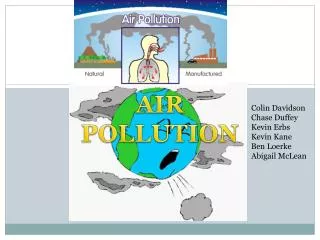
Outdoor Air Pollution • airborne particles and gasses • concentrations that endanger: • heath and well-being of organisms • disrupt the orderly functioning of the environment • (1) primary pollutants: emitted directly from identifiable sources, and • (2) secondary pollutants: produced in the atmosphere when certain chemical reactions take place among primary pollutants.
Secondary Pollutants • Atmospheric sulfuric acid is one example of a secondary pollutant. • Air pollution in urban and industrial areas is often called smog. • Photochemical smog, a noxious mixture of gases and particles, is produced when strong sunlight triggers photochemical reactions in the atmosphere. • The major component of photochemical smog is ozone.
Photochemical Smog • Brown-air smog • Photochemicalreaction • Photochemicaloxidants
Regional Outdoor Air Pollution from Acid Deposition • Acid deposition • Dry deposition • Wet deposition
Acid Deposition and Humans • Respiratory diseases • Toxic metal leaching • Decreased visibility • Damage to structures, especially containing limestone • Decreased productivity and profitability of fisheries, forests, and farms
Acid Deposition and Aquatic Systems • Fish declines • Undesirable species • Aluminum toxicity • Acid shock
Acid Deposition, Plants, and Soil • Nutrient leaching • Heavy metal release • Weakens trees
Radon • Radon-222 • Occurs in certain areas based on geology • Associated with uranium and organic material in rock • 2nd most common cause of lung cancer
Air Pollution Occurrences • quantity of contaminants emitted into the atmosphere • changes in certain atmospheric conditions • (1) the strength of the wind and • (2) the stability of the air.
Air Mixing • Wind speed affects concentration of pollutants • Atmospheric stability determines extent to which vertical motions mix pollution with cleaner air above the surface layers • Mixing depth: vertical distance between Earth's surface and the height to which convectional movements extend • Greater the mixing depth, the better the air quality • Air temp differences lead to differences in air density
Inversions • Temperature inversions: atmosphere very stable and the mixing depth significantly restricted • Diffusion is inhibited and high pollution concentrations are to be expected in areas where pollution sources exist
This is an example of a generalized temperature profile for a surface inversion. Temperature-profile changes in bottom diagram after the sun has heated the surface.
Controlling Air Pollution through Regulations • Economic activity, population growth, meteorological conditions, and regulatory efforts to control emissions, all influence the trends in air pollution. • The Clean Air Act of 1970 mandated the setting of standards for four of the primary pollutants— • particulates, • sulfur dioxide, • carbon monoxide, and • Nitrogen • as well as the secondary pollutant ozone.
Key Terminology “Natural” air pollution Primary pollutants Secondary pollutants Smog Photochemical smog Ozone Clean Air Act (1970) Acid Precipitation Mixing depth Inversion Surface inversion