Advancements in Colicin Fragment Research: Contributions and Discoveries
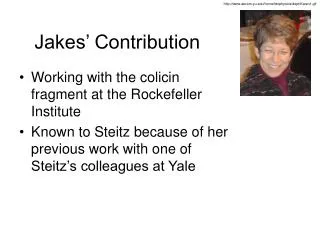
This document provides an overview of Karen Jakes' significant contributions to biophysics, particularly her work on the colicin fragment at the Rockefeller Institute. Jakes was previously known to Walter Steitz through earlier collaborations at Yale. Her research focused on the advantages of the colicin fragment, which includes its optimal length and stability for studying colicin/ribosomal binding. Despite advancements in technology favoring RNAse H for these studies today, Jakes' work remains foundational in understanding protein interactions in biophysics.

Advancements in Colicin Fragment Research: Contributions and Discoveries
E N D
Presentation Transcript
http://www.aecom.yu.edu/home/biophysics/dept/Karen1.gif Jakes’ Contribution • Working with the colicin fragment at the Rockefeller Institute • Known to Steitz because of her previous work with one of Steitz’s colleagues at Yale
Advantages to Colicin Only one fragment, appropriate length and stability Previous research showed colicin/ribosomal binding Today: would more likely used RNAse H, but this was not present at the time http://www.ionchannels.org/pdb-image/3EIP.jpg