Enhancing Student Learning Through Project-Based Research Modules
This professional learning workshop aims to develop attendees' understanding of research modules that promote higher-level thinking, utilizing both electronic and print resources. Participants will explore the research cycle, evaluate existing modules, and identify qualities of effective project-based learning. The workshop equips elementary teachers with practical tools and insights for implementing inquiry-based methods in the classroom, aligning with state standards. By focusing on collaboration and evaluation techniques, educators will leave with strategies to enhance student engagement and critical thinking skills.

Enhancing Student Learning Through Project-Based Research Modules
E N D
Presentation Transcript
Modules Project Based Learning Pamela Costello December 17, 2006
ALP Professional Learning Program • 16 Elementary 3-5 ALP Teachers • Web Browser - Firefox or Explorer • Mac OS X 1.83 GHz Intel Core Duo • Memory 1 GB DDR2 SDRAM • Microsoft Office http://www.pcauthority.com.au/review.aspx?CIaRID=2349
Objectives for Today • Define a research module. • Understand how the research cycle is applied in a module project. • Review created modules. • Identify qualities in effective modules.
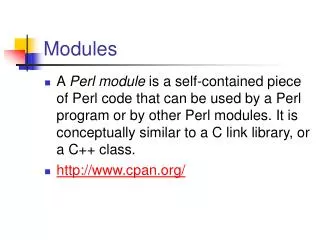
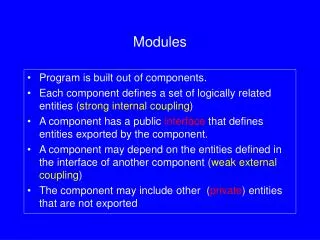
Modules Structured and guided student research that involves • higher level thinking • electronic resources • good print resources like books • live data such as interviews • addressing new state standards http://questioning.org/module/module.html
The Research Cycle http://questioning.org/Q6/research.html
Designing a Module using the Research Cycle http://questioning.org/module/cycle.html
Evaluating Modules- Activity With a partner, choose one site to rate from 0 to 4 stars depending upon quality and based on the criteria provided. • 0 stars – does not meet quality • 1 star – meets quality at very basic level • 2 stars –meets quality at sound level • 3 stars – meets quality quite strongly • 4 stars – meets quality in exemplary fashion http://questioning.org/module/cycle.html
Modules To Evaluate Go West Planetary Adventures Tourist Travels Greek Life
Time to Evaluate Assessment Rubric (Handout) Please indicate your agreement or disagreement with the following statements: Strongly Disagree Strongly Agree This workshop meet the objectives given. 1 2 3 4 Modules are a tool that I will experiment with in the near future 1 2 3 4 I have gained insight into how evaluate current modules I may find online 1 2 3 4 My students will benefit from this workshop 1 2 3 4 This workshop will help me In my teaching. 1 2 3 4 Comments:
Works Consulted • http://www.pcauthority.com.au/review.aspx?CIaRID=2349 • McKenzie Jamie (1997) The Module Maker. Retrieved from the Website http://questioning.org/Q6/question.html • McKenzie J. (1997) The Module Maker. Retrieved December 16, 2007 from the Website http://questioning.org/rcycle.htm • Foast, Debra. (2000) Welcome to Greece.http://www.iwms.wlwv.k12.or.us/COMMON/6thGrade/Greek/guided.htm • Retrieved December 16, 2007 from the Website http://www.cap.nsw.edu.au/bb_site_intro/stage3_Modules/TouristTravels/tourist_travels.htm • Jones, et al.(2000). Go Westhttp://www.bcpl.net/~sullivan/modules/gowest/index.html • Offutt, Gretchen. (1999) Planetary Adventure Camp. http://wwwsil.bham.wednet.edu/Curriculum/Planetary_Adventure/paBASECAMP.HTM
Conclusion • Modules involve higher level thinking • Students develop research skills using an inquiry-based method • Scaffolding supports differentiation • Preparing students for research in the 21st century