Bond Prices and Yields
Bond Prices and Yields. 10. Bodie, Kane, and Marcus Essentials of Investments, 9 th Edition. 10.1 Bond Characteristics. Bond Security that obligates issuer to make payments to holder over time Face Value, Par Value Payment to bondholder at maturity of bond Coupon Rate

Bond Prices and Yields
E N D
Presentation Transcript
Bond Prices and Yields 10 Bodie, Kane, and Marcus Essentials of Investments, 9th Edition
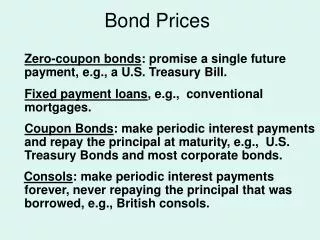
10.1 Bond Characteristics • Bond • Security that obligates issuer to make payments to holder over time • Face Value, Par Value • Payment to bondholder at maturity of bond • Coupon Rate • Bond’s annual interest payment per dollar of par value • Zero-Coupon Bond • Pays no coupons, sells at discount, provides only payment of par value at maturity
Figure 10.1 Prices/Yields of U.S. Treasury Bonds U.S. Treasury Quotes: Treasury note and bond data are representative over-the-counter quotations as of 3pm Eastern time.
10.1 Bond Characteristics • Corporate Bonds • Call provisions on corporate bonds • Callable bonds: May be repurchased by issuer at specified call price during call period • Convertible bonds • Allow bondholder to exchange bond for specified number of common stock shares
10.1 Bond Characteristics • Corporate Bonds • Puttable bonds • Holder may choose to exchange for par value or to extend for given number of years • Floating-rate bonds • Coupon rates periodically reset according to specified market date
10.1 Bond Characteristics • Preferred Stock • Commonly pays fixed dividend • Floating-rate preferred stock becoming more popular • Dividends not normally tax-deductible • Corporations that purchase other corporations’ preferred stock are taxed on only 30% of dividends received
10.1 Bond Characteristics • Other Domestic Issuers • State, local governments (municipal bonds) • Federal Home Loan Bank Board • Farm Credit agencies • Ginnie Mae, Fannie Mae, Freddie Mac
10.1 Bond Characteristics • International Bonds • Foreign bonds • Issued by borrower in different country than where bond sold, denominated in currency of market country • Eurobonds • Denominated in currency (usually that of issuing country) different than that of market
10.1 Bond Characteristics • Innovation in the Bond Market • Inverse floaters • Coupon rate falls when interest rates rise • Asset-backed bonds • Income from specified assets used to service debt • Pay-in-kind bonds • Issuers can pay interest in cash or additional bonds • Catastrophe bonds • Higher coupon rates to investors for taking on risk
Table 10.1 Principal and Interest Payments Principal and interest payments for a Treasury Inflation Protected Security
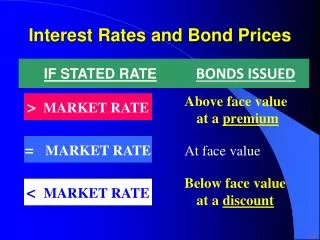
10.2 Bond Pricing • Prices fall as market interest rate rises • Interest rate fluctuations are primary source of bond market risk • Bonds with longer maturities more sensitive to fluctuations in interest rate
Figure 10.3 Inverse Relationship between Bond Prices and Yields
10.2 Bond Pricing • Bond Pricing between Coupon Dates • Invoice price = Flat price + Accrued interest • Bond Pricing in Excel • =PRICE (settlement date, maturity date, annual coupon rate, yield to maturity, redemption value as percent of par value, number of coupon payments per year)
10.3 Bond Yields • Yield to Maturity • Discount rate that makes present value of bond’s payments equal to price. • Current Yield • Annual coupon divided by bond price • Premium Bonds • Bonds selling above par value • Discount Bonds • Bonds selling below par value
10.3 Bond Yields • Yield to Call • Calculated like yield to maturity • Time until call replaces time until maturity; call price replaces par value • Premium bonds more likely to be called than discount bonds
10.3 Bond Yields • Realized Compound Returns versus Yield to Maturity • Realized compound return • Compound rate of return on bond with all coupons reinvested until maturity • Horizon analysis • Analysis of bond returns over multiyear horizon, based on forecasts of bond’s yield to maturity and investment options • Reinvestment rate risk • Uncertainty surrounding cumulative future value of reinvested coupon payments
10.4 Bond Prices Over Time • Yield to Maturity versus Holding Period Return (HPR) • Yield to maturity measures average RoR if investment held until bond matures • HPR is RoR over particular investment period; depends on market price at end of period
Figure 10.6 Price Paths of Coupon Bonds in Case of Constant Market Interest Rates
10.4 Bond Prices Over Time • Zero-Coupon Bonds and Treasury STRIPS • Zero-coupon bond: Carries no coupons, provides all return in form of price appreciation • Separate Trading of Registered Interest and Principal of Securities (STRIPS): Oversees creation of zero-coupon bonds from coupon-bearing notes and bonds
Figure 10.7 Price of 30-Year Zero-Coupon Bond over Time at Yield to Maturity of 10%
10.4 Bond Prices Over Time • After-Tax Returns • Built-in price appreciation on original-issue discount bonds constitutes implicit interest payment to holder • IRS calculates price appreciation schedule to determine taxable interest income for built-in appreciation
10.5 Default Risk and Bond Pricing • Investment grade bond • Rated BBB and above by S&P or Baa and above by Moody’s • Speculative grade or junk bond • Rated BB or lower by S&P, Ba or lower by Moody’s, or unrated
10.5 Default Risk and Bond Pricing • Determinants of Bond Safety • Coverage ratios: Company earnings to fixed costs • Leverage ratio: Debt to equity • Liquidity ratios • Current: Current assets to current liabilities • Quick: Assets excluding inventories to liabilities • Profitability ratios: Measures of RoR on assets or equity • Cash flow-to-debt ratio: Total cash flow to outstanding debt
10.5 Default Risk and Bond Pricing • Bond Indentures • Indenture • Defines contract between issuer and holder • Sinking fund • Indenture calling for issuer to periodically repurchase some proportion of outstanding bonds before maturity
10.5 Default Risk and Bond Pricing • Bond Indentures • Subordination clause • Restrictions on additional borrowing stipulating senior bondholders paid first in event of bankruptcy • Collateral • Specific asset pledged against possible default • Debenture • Bond not backed by specific collateral
10.5 Default Risk and Bond Pricing • Yield to Maturity and Default Risk • Stated yield is maximum possible yield to maturity of bond • Default premium • Increment to promised yield that compensates investor for default risk
Figure 10.10 Yield Spreads between Corporate and 10-Year Treasury Bonds
10.5 Default Risk and Bond Pricing • Credit Default Swaps (CDS) • Insurance policy on default risk of corporate bond or loan • Designed to allow lenders to buy protection against losses on large loans • Later used to speculate on financial health of companies
10.6 The Yield Curve • Yield Curve • Graph of yield to maturity as function of term to maturity • Term Structure of Interest Rates • Relationship between yields to maturity and terms to maturity across bonds • Expectations Hypothesis • Yields to maturity determined solely by expectations of future short-term interest rates
Figure 10.15 Term Spread: Yields on 10-Year versus 90-day Treasury Securities