Understanding Order of Operations in Arithmetic: BEDMAS Explained
In this lesson, we explore the importance of the order of operations when solving arithmetic expressions. We will evaluate various expressions, including example problems involving addition, subtraction, multiplication, division, and more complex calculations with brackets and exponents. Following the BEDMAS rules (Brackets, Exponents, Division/Multiplication, Addition/Subtraction) is crucial for getting the correct answer. We will also provide practice problems to reinforce your understanding of which operations to perform first.


Understanding Order of Operations in Arithmetic: BEDMAS Explained
E N D
Presentation Transcript
ORDER OF OPERATIONS LESSON 2
Something to Think About: Does the order matter? • -5 + 4 = • 10 – 3 + 1 = • 4 x 6 ÷ 2 = • 9 ÷ 3 x 6 = • 4 + (-5) = • 1 – 3 + 10 = • 4 ÷ 2 x 6 = • 6 ÷ 3 x 9 =
How about now? • 5 x 2 – 4 = • What would happen if we did the subtractions first/ • 2 – 4 x 5 = • So how do we know what to do first?
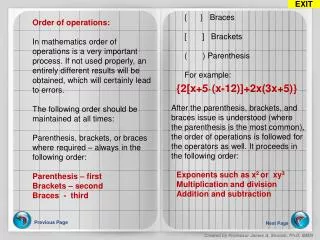
RULES TO FOLLOW • Rule 1: • Simplify all operations inside brackets. • Rule 2: • Simplify all exponents, working from left to right. • Rule 3: • Perform all multiplications and divisions, working from left to right. • Rule 4: • Perform all additions and subtractions, working from left to right.
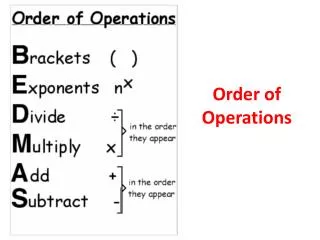
BEDMAS • B – Brackets • E – Exponents • D – Division from left to right • M – Multiply from left to right • A – Add from left to right • S – Subtract from left to right
EXAMPLE 1 • Evaluate this arithmetic expression • 18 + 36 ÷ 32 • SOLUTION:
EXAMPLE 1 • Evaluate this arithmetic expression • 18 + 36 ÷ 32 • SOLUTION:
EXAMPLE 1 • Evaluate this arithmetic expression • 18 + 36 ÷ 32 • SOLUTION:
EXAMPLE 2 • Evaluate 52 x 24 • Solution:
EXAMPLE 2 • Evaluate 52 x 24 • Solution:
EXAMPLE 2 • Evaluate 52 x 24 • Solution:
EXAMPLE 2 • Evaluate 52 x 24 • Solution:
EXAMPLE 3 • EVALUATE 289 – (3 X 5)2
EXAMPLE 3 • EVALUATE 289 – (3 X 5)2 • SOLUTION:
EXAMPLE 3 • EVALUATE 289 – (3 X 5)2 • SOLUTION:
EXAMPLE 3 • EVALUATE 289 – (3 X 5)2 • SOLUTION:
EXAMPLE 3 • EVALUATE 289 – (3 X 5)2 • SOLUTION:
EXAMPLE 4 • EVALUATE 8 + (2 x 5) x 34÷ 9
EXAMPLE 4 • EVALUATE 8 + (2 x 5) x 34÷ 9 • SOLUTION:
EXAMPLE 4 • EVALUATE 8 + (2 x 5) x 34÷ 9 • SOLUTION:
EXAMPLE 4 • EVALUATE 8 + (2 x 5) x 34÷ 9 • SOLUTION:
EXAMPLE 4 • EVALUATE 8 + (2 x 5) x 34÷ 9 • SOLUTION:
EXAMPLE 4 • EVALUATE 8 + (2 x 5) x 34÷ 9 • SOLUTION:
EXAMPLE 4 • EVALUATE 8 + (2 x 5) x 34÷ 9 • SOLUTION:
Example 5 • When you have a division questions like this, it is the same as having brackets around everything on the top and bottom.
YOU TRY THESE • 1) 32 x 43 • 2) 27 – 256 ÷ 43 • 3) 9 x (5 + 3)2 – 144 • 4) 7 + 3 x 24 ÷ 6
1) 32 x 43 • Solution:
2) 27 – 256 ÷ 43 • Solution:
3) 9 x (5 + 3)2 – 144 • Solution:
4) 7 + 3 x 24 ÷ 6 • Solution: