Discovering the Sun: Its Structure, Reactions, and Atmospheric Features
This lesson explores the Sun, the only star in our solar system, focusing on its structure, fusion reactions, and atmospheric layers. Students will learn about the Sun's core, radiation zone, and convection zone, as well as its various atmospheric features including the photosphere, chromosphere, and corona. We will discuss phenomena such as sunspots, prominences, and solar flares, all while delving into the science of nuclear fusion that powers our Sun. Through videos and discussions, students will gain a deeper understanding of the Sun's vital role in our solar system.

Discovering the Sun: Its Structure, Reactions, and Atmospheric Features
E N D
Presentation Transcript
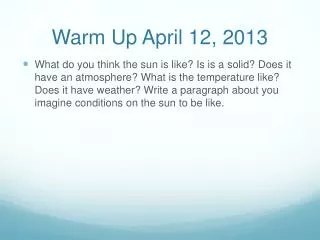
Warm Up April 12, 2013 • What do you think the sun is like? Is is a solid? Does it have an atmosphere? What is the temperature like? Does it have weather? Write a paragraph about you imagine conditions on the sun to be like.
Agenda • Warm Up • Review HW • 14.2 Notes • “the Universe: Secrets of the Sun” Video • Cool Down
14.2 The Sun • Only star in our solar system • Average sized star • Accounts for 99.8% of the mass in our solar system
The sun is not “on fire.” • Fires are chemical reactions where atoms are rearranged. • In the sun, nuclear reactions are occurring where the nulcei of atoms are rearranged.
Fusion • Fusion reactions inside the sun provide the sun’s energy. • In fusion reactions, two small nuclei combine to form one larger nuclei. • Some mass is lost in the process and this mass is converted to enormous amounts of energy.
Inside the Sun • Fusion happens in the sun’s corewhere temperatures are extremely high. • The radiation zone is a huge layer of very dense gases around the core. It can take 100,000 years for a particle to pass through it. • The convection zone: Is the outmost layer of the sun’s interior. Hot and cold currents move gases around.
The Sun’s Atmosphere • Photosphere: is the visible surface of the sun. photo=light • Chromosphere: is what you see in a total solar eclipse. chromo=color • Corona: is the outermost layers of the sun’s atmosphere and is visible during a totoal solar eclipse. corona=crown
Features on the Sun • Sunspots: are areas of gases on the sun’s surface that are cooler than the areas around them • Prominences: are loops of gases in the corona. • Solar Flares: occur when loops connect, releasing large amounts of gas and energy into space.
Auroras • Aurora Borealis = Northern Lights
Cool Down • Title: Sun Brace Map • P. 550 #1a-c, #2a-c, #3a-b • 14.2 Vocab Booklet (11 words on p. 545) Interior Sun Atmosphere Features Homework