Quantum Simulations with Trapped Yb+ Ions in Scalable DC and RF Systems
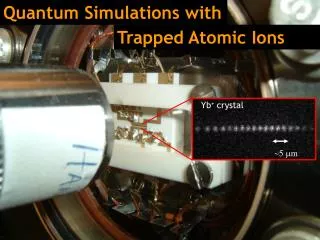
This study explores quantum simulations using trapped atomic ions of Ytterbium (Yb+) within a 5 mm crystal structure utilizing a three-layer geometry. The setup features single RF electrodes, scalable to larger frameworks, which are optimal for junctions integrating DC and RF fields. We highlight the hyperfine spin states of 171Yb+ ions, achieving over 99% detection efficiency and high precision in spin control through advanced manipulation techniques. This research presents significant advancements in trapped ion quantum computing and entanglement, focusing on minimizing phonon creation during interactions.

Quantum Simulations with Trapped Yb+ Ions in Scalable DC and RF Systems
E N D
Presentation Transcript
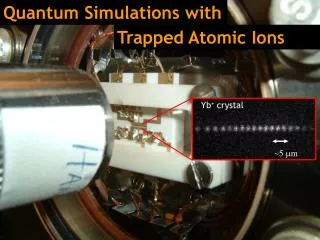
Quantum Simulations with • Trapped Atomic Ions Yb+ crystal ~5 mm
dc dc rf rf dc dc • 3-layer geometry: • single rf electrode • scalable to larger structures, natural for junctions dc dc rf rf dc dc
171Yb+hyperfine spin | = |1,0 wHF/2p = 12 642 812 118 + 311B2Hz 2S1/2 (600 Hz/G @ 1 G) | = |0,0
1 Probability 0 0 5 10 15 20 25 # photons collected in 800 ms 171Yb+ spin detection g/2p = 20 MHz 2P1/2 2.1 GHz |z 369 nm | wHF/2p = 12 642 812 118 + 311B2Hz 2S1/2 (600 Hz/G @ 1 G) |
1 >99% detection efficiency Probability 0 0 5 10 15 20 25 # photons collected in 500 ms 171Yb+ spin detection g/2p = 20 MHz 2P1/2 2.1 GHz |z |z 369 nm | wHF/2p = 12 642 812 118 + 311B2Hz 2S1/2 (600 Hz/G @ 1 G) |
171Yb+ spin manipulation g/2p = 20 MHz 2P3/2 D = 33 THz 2P1/2 355 nm (10 psec @ 100 MHz) | wHF/2p = 12 642 812 118 + 311B2Hz 2S1/2 (600 Hz/G @ 1 G) |
National Ignition Facility: 351nm (Livermore National Laboratory) Pavg ~ 5W at 355nm 10 psec pulses, 120 MHz rep rate 1 0 P(↑|↓) picosecond spin control 0 10 20 30 pulse energy (nJ) See talk by Jonathan Mizrahi (Sunday) J. Mizrahi, et al., ArXiv 1307.0557 (2013)
Internal states of these ions entangled Trapped Ion Quantum Computer (Cirac-Zoller) Cirac and Zoller, Phys. Rev. Lett. 74, 4091 (1995) CM, et al., Phys. Rev. Lett. 74, 4714 (1995) Q. Turchette, et al., Phys. Rev. Lett. 81, 3631 (1998) F. Schmidt-Kaler, et al., Nature 422, 408 (2003)
Internal states of these ions entangled Trapped Ion Quantum Computer (Cirac-Zoller) Cirac and Zoller, Phys. Rev. Lett. 74, 4091 (1995) CM, et al., Phys. Rev. Lett. 74, 4714 (1995) Q. Turchette, et al., Phys. Rev. Lett. 81, 3631 (1998) F. Schmidt-Kaler, et al., Nature 422, 408 (2003)
Cirac-Zoller: number states of the QHO • extreme cooling: requires a pure motional state • not scalable: mode density problem 1 • Better: “spin-dependent displacements” • only requires cooling to the • Lamb-Dicke limit • “virtual” coupling to phonons • Possible • Mølmer & Sørensen (1999) • Solano, de Matos Filho, Zagury (1999) • Milburn, Schneider, James (2000) =
F = F0|↑↑| - F0|↓↓| global spin-dependent force
B ↑ ↓ ↓ ↑ ↓ ↑ ↓ ↑ ↓ ↑ ↓ ↑ ↓ ↑ ↓ ↑ ↓ ↑ ↓ ↑ ↓ ↑ ↓ ↑ ↓ ↑ ↓ ↑ ↓ ↑ ↓ ↑ ↓ ↑ ↓ ↑ ↓ ↑ ↓ ↑ ↓ ↑ ↓ ↑ ↓ ↑ ↓ ↑ | | ADD: Independent spin flips global spin-dependent force F = F0|↑↑| - F0|↓↓|
spin-dependent force (171Yb+) B(x) 1,1 1,0 1,-1 Magnetic field gradient 2P1/2 0,0 1,1 1,0 1,-1 | 2S1/2 0,0 |
spin-dependent force (171Yb+) s+ s+ 1,1 1,0 1,-1 Position-dependent AC Stark shift 2P1/2 0,0 D 369 nm g 1,1 1,0 1,-1 | 2S1/2 0,0 |
spin-dependent force (171Yb+) Red+blue sideband applied simultaneously 1,1 1,0 1,-1 2P1/2 0,0 D 369 nm g g | g 1,0 1,1 1,-1 Lamb-Dicke parameter = 2S1/2 0,0 |
global spin-dependent oscillating force simultaneous sidebands Lamb-Dicke approximation: normal mode decomposition † normal mode transformation matrix: ion i, mode k
Aside: transverse Modes of an atom chain transverse modes . . . frequency transverse modes axial modes . . . . . . frequency S.-L. Zhu et al., Phys. Rev. Lett. 97, 050505 (2006) A. Serafini et al., New J. Phys. 11, 023007 (2009)
Raman spectrum of N=9 ions fluorescence ~ N() (Dk nominally along x) transverse y axial z ZigZag COM COM transverse x ZigZag COM Raman beatnote (MHz)
global spin-dependent oscillating force carrier lower sidebands upper sidebands Raman beatnotes: wHF±m wHF -m wHF+m frequency †
† † evolution operator phonons interaction between qubits (entangling gates etc..)
How to avoid phonon creation? (1) Pick detuning m and time t wisely “FAST MOLMER” for all modes k e.g.: m near single mode k only → (m-wk)t = 2pm m=1,2,… S.-L. Zhu, et al., Europhys Lett. 73 (4), 485 (2006).
“FAST MOLMER” p x Rabi frequency Beatnote frequency
How to avoid phonon creation? (1) Pick detuning m and time t wisely “FAST MOLMER” for all modes k e.g.: m near single mode k only → (m-wk)t = 2pm m=1,2,… S.-L. Zhu, et al., Europhys Lett. 73 (4), 485 (2006). (2) “Adiabatically eliminate” phonons: |m - wk| >> hW0“SLOW MOLMER”
“SLOW MOLMER” p x Rabi frequency Beatnote frequency
How to avoid phonon creation? (2) “Adiabatically eliminate” phonons: |m - wk| >> hW0“SLOW MOLMER”