Download
1 / 2
20 likes | 141 Vues
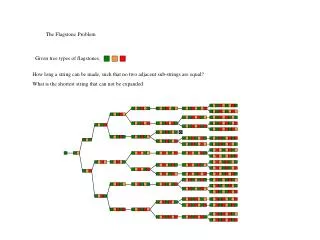
The Flagstone Problem presents a unique challenge involving the formation of strings from specified types of flagstones. The objective is to determine the maximum length of a string that can be constructed such that no two adjacent substrings are identical. Additionally, the problem seeks to identify the shortest string configuration that cannot be expanded within these parameters. By analyzing the provided sequences, we unravel complex patterns and aggregation tactics that may offer solutions to this intriguing problem.

E N D
The Flagstone Problem Given tree types of flagstones. How long a string can be made, such that no two adjacent sub-strings are equal? What is the shortest string that can not be expanded
0 0 0 0 0 0 1 1 1 1 1 1 1 1 0 0 0 0 1 0 0 1 0 1 1 0 1 0 0 1 1 0 0 1 0 1 1 0 1 0 0 1 0 1 1 0 0 .. .. .. 2 1 0 2 0 1 2 1 0 1 2 0 0 1 10 11 100 101 110 111 1000 1001 1010 1011 1100 1101 1110 1111 10000 10001 10010 10011 10100 10101 10110 10111 11000 ... ... ... 0,210201210120…. Terminal