Download
1 / 3
30 likes | 143 Vues
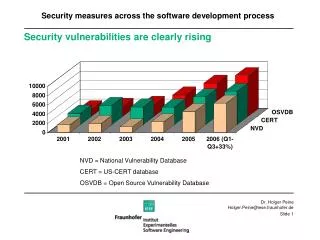
Software vulnerabilities are on the rise, as revealed by various databases such as the National Vulnerability Database (NVD) and the Open Source Vulnerability Database (OSVDB). A study from Carnegie Mellon University (2004) found that each vulnerability announcement led to an average stock price drop of 0.6%, costing vendors significantly. The majority of vulnerabilities stem from poor programming practices, with 64% attributed to programming errors. Prominent issues include buffer overflows and cross-site scripting, highlighting the urgent need for improved software security measures.

E N D
Security vulnerabilities are clearly rising NVD = National Vulnerability Database CERT = US-CERT database OSVDB = Open Source Vulnerability Database
Published vulnerabilities cost a vendor real money • A study based on reald vulnerability announcements in 1999-2004 revealed an • average drop of the concerned vendor's stock price • of 0.6% after each vulnerability announcement • Tehang / Wattal, Carnegie Mellon Univerisity, 2004 • "Impact of Software Vulnerability Announcements on the Market Value of Software Vendors – an Empirical Investigation" • ... not to mention the damage to the vendor's reputation
Most vulnerabilities caused by careless programming • 64% of the vulnerabilities in ICAT (now: NVD) in 2004 are due to programming errors • 51% of those due to classic errors like buffer overflows, cross-site-scripting, injection flaws • Heffley/Meunier (2004): Can Source Code Auditing Software Identify Common Vulnerabilities and Be Used to Evaluate Software Security? • Cross-site scripting, SQL injection at top of the statistics (CVE, Bugtraq) in 2006 • "We wouldn't need so much network security if we didn't have such bad software security" (Bruce Schneier)