Download
1 / 17
170 likes | 277 Vues
Discover the wonders of our Solar System, including the eight planets, their unique features, and the regions filled with asteroids and comets. From the rocky terrains of Mercury and Mars to the gas giants like Jupiter and Saturn, learn about the environments that define these celestial bodies. Delve into the Asteroid Belt, Kuiper Belt, and the Oort Cloud, and understand the difference between meteoroids, meteors, and meteorites. Join us on a journey through the cosmos and unravel the mysteries of space.

E N D
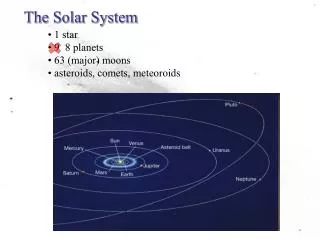
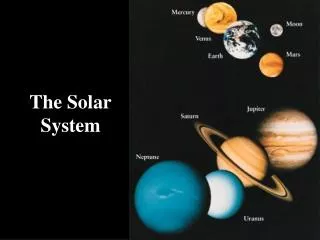
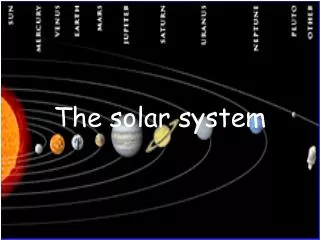
Our Solar System In order • Mercury • Venus • Earth • Mars • Asteroid Belt • Jupiter • Saturn • Uranus • Neptune • Kuiper Belt • Oort Cloud
Terrestrial Planets • Mercury • Venus • Earth • Mars • All have a rocky crust, a denser mantle, and a very dense core
The Jovian Planets • Jupiter, Saturn, Uranus and Neptune • A solid rock core • A liquid mantle • An outer gas layer • A ring system
Mercury: Closest to the Sun • 1 solar orbit takes 88 days • Rotates on axis every 58.6 days • Temperatures range from 425 degrees C to -150 degrees C
Venus: The 2nd Planet • Atmosphere is made of sulfuric acid clouds and CO2 • Surface is covered in faults, lava, and volcanoes • Temperatures in excess of 480 degrees C
Mars: 4th from the Sun • Has polar ice caps made mainly of CO2 • 27 degrees C during the day -125 degrees C at night • Orbits the sun every 637 days
Jupiter: The 5th Planet • Takes 11.9 years to orbit the sun • Surface is made of alternating light/dark bands of gas
Saturn: The 6th Planet • 29.7 years to orbit the sun • Known for its rings, which are made of rock and ice
Uranus: The 7th Planet • Takes 84 years to orbit the sun • -200 degrees C
Neptune: The 8th Planet • 165 years to orbit the sun • Gives off 2.7 times more heat than it receives • Fastest wind in the solar system (2200 km/hr)
Asteroid Belt • Asteroid: Solid rock masses floating in space • Asteroid Belt: Zone of multiple asteroids between Mars and Jupiter
Kuiper Belt • Area of objects from the orbit of Neptune (30.1 AU) to 50 Au from the sun • Smaller objects, hard to see and identify (size & light)
The Oort Cloud • Outer most area of our solar system • 50,000AU to 100,000AU distance from the sun • Spherical cloud of comets
Comets • A mass of rock, gas, and dust that orbits the sun • Usually has a highly elliptical orbit • Tail is caused by solar wind flying past the body of the comet
Meteors, Meteoroids, & Meteorites • Meteoroids are any rock or ice fragment traveling in space • A meteor is the light made when a meteoroid passes through our atmosphere • A meteorite is any piece of a meteoroid that survives its trip through the atmosphere and hits our surface