Utilizing TI Calculator for Matrix Operations: A Guide to Determinants and Multiplication
This guide explains how to effectively use the 2nd MATRIX button on the TI calculator for various matrix operations, including recalling stored matrices with NAMES and performing mathematical functions listed under MATH. Key focuses include calculating determinants (det) and reduced row echelon forms (rref). It also emphasizes the importance of storing and organizing matrices using the STO button, especially for applications like Cramer’s Rule. Furthermore, it breaks down matrix multiplication, illustrating how it links characteristics of different models through effects of materials and costs.

Utilizing TI Calculator for Matrix Operations: A Guide to Determinants and Multiplication
E N D
Presentation Transcript
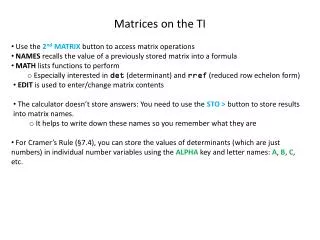
Matrices on the TI • Use the 2nd MATRIX button to access matrix operations • NAMES recalls the value of a previously stored matrix into a formula • MATH lists functions to perform • Especially interested in det (determinant) and rref (reduced row echelon form) • EDIT is used to enter/change matrix contents • The calculator doesn’t store answers: You need to use the STO > button to store results into matrix names. • It helps to write down these names so you remember what they are • For Cramer’s Rule (§7.4), you can store the values of determinants (which are just numbers) in individual number variables using the ALPHA key and letter names: A, B, C, etc.
Matrix Multiplication:§7.4 Example 10, pg 508A Good Example of Why Matrix Multiplication Makes Sense All matrices classify how one characteristic of a situation is effected by another. This is true even in geometric or other abstract situations. “Materials” is effected by “Cost”: A unit of concrete costs $20 “Model” is effected by “Style”: 20 Y’s are to be made in the Ranch style “Style” is effected by “Materials”: A ranch is made up of 50 units of concrete $ Colonial Ranch Concrete Lumber Brick Shingles Concrete Lumber Brick Shingles Model X Model Y Model Z Colonial Ranch Multiplication links up a chain of effects: (Model vs. Style) × (Style vs. Materials) × (Materials vs. Cost) = (Model vs.Cost)
Enter into the TI using 2nd MATRIX, EDIT NAMES MATH EDIT 1: [A] 2: [B] 3: [C] 4: [D] 5: [E] 6 ↓ [F] EDIT MATRIX [A] 3 X 2 [0 30 ] [10 20 ] [20 20 ] 3,2=20 1: ENTER 20 2nd MATRIX, EDIT: NAMES MATH EDIT 1: [A] 3X2 2: [B] 3: [C] 4: [D] 5: [E] 6 ↓ [F] EDIT MATRIX [B] 2 X 4 _2 0 2 ] _1 20 2 ] 2,4=2 2: 2 ENTER
2nd MATRIX, EDIT: NAMES MATH EDIT 1: [A] 3X2 2: [B] 2X4 3: [C] 4: [D] 5: [E] 6 ↓ [F] EDIT MATRIX [C] 4 X 1 [20 ] [180 ] [60 ] [25 ] 4,1=25 ENTER 3: 25 2nd QUIT
We can also do a “Total” matrix which gives the total number of each Model (for question (b) of the Example): Model X Model Y Model Z Total 2nd MATRIX, EDIT: NAMES MATH EDIT 1: [A] 3X2 2: [B] 2X4 3: [C] 4X1 4: [D] 5: [E] 6 ↓ [F] EDIT MATRIX [F] 1 X 3 [ 1 1 1 ] 1,3=1 1 ENTER 6: 2nd QUIT
(a) What is the total cost of materials for all houses of each model? (Model vs.Cost) = (Model vs. Style) × (Style vs. Materials) × (Materials vs. Cost) = A B C NAMES MATH EDIT 1: [A] 3X2 2: [B] 2X4 3: [C] 4X1 4: [D] 5: [E] 6 ↓ [F] 1X3 NAMES [A]* 1: 2nd MATRIX, NAMES: ENTER, × NAMES MATH EDIT 1: [A] 3X2 2: [B] 2X4 3: [C] 4X1 4: [D] 5: [E] 6 ↓ [F] 1X3 [A]*[B]* NAMES 2nd MATRIX, NAMES: ENTER, × 2:
NAMES MATH EDIT 1: [A] 3X2 2: [B] 2X4 3: [C] 4X1 4: [D] 5: [E] 6 ↓ [F] 1X3 NAMES [A]*[B]*[C] [ [72900] [54700] [60800] ] ENTER, ENTER 2nd MATRIX, NAMES: 3: $ Model X Model Y Model Z
(b) How much of each of the four kinds of material must be ordered? (Model vs.Materials) = (Model vs. Style) × (Style vs. Materials) = A B [A]*[B] [ [1500 30 600 6… [1100 40 400 6… [1200 60 400 8… [A]*[B] …500 30 600 60] …100 40 400 60] …200 60 400 80]] STO >, 2nd MATRIX, NAMES, [E] [A]*[B] [ [1500 30 600 6… [1100 40 400 6… [1200 60 400 8… Ans→[E] [ [1500 30 600 6… [1100 40 400 6… [1200 60 400 8… Concrete Lumber Brick Shingles Model X Model Y Model Z
The totals can be found by multiplying by the (Total vs. Model) matrix Concrete Lumber Brick Shingles Model X Model Y Model Z Model X Model Y Model Z Total [F]*[E] [ [3800 130 1400 200] ] Concrete Lumber Brick Shingles Total
(c) Find the total cost of the materials (Total vs. Cost) = (Total vs. Materials) × (Materials vs. Cost) [F]*[E] [ [3800 130 1400 200] ] Ans*[C] [ [188400] ] 2nd ANS $ Total
![[MATRICES ]](https://cdn4.slideserve.com/144276/matrices-dt.jpg)