Exploring the Area Between a Continuous Function and the X-Axis on a Journey from CC-San Antonio
Join us on a mathematical journey as we explore the area between a continuous function and the x-axis, illustrating concepts such as rise/run, average velocity, and distance over time. We will use rectangles, trapezoids, and grid techniques to estimate areas, applying basic geometry to calculate the area beneath the graph. By analyzing graphs through left-hand and right-hand sums, we’ll uncover overestimates and underestimates. Finally, we’ll apply these methods to determine average distance traveled on a trip from CC to San Antonio.

Exploring the Area Between a Continuous Function and the X-Axis on a Journey from CC-San Antonio
E N D
Presentation Transcript
Trip from CC-San Antonio Make a narrative for the trip
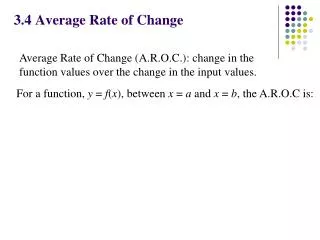
Units of Line and Area Rise/run = miles/hour Fill region with rectangles Units of area = length*width = hours*miles
What is the average velocity (rate of change of distance)? • What is the average distance from CC during the traveled time? • What degree polynomial would you use to fit this graph?
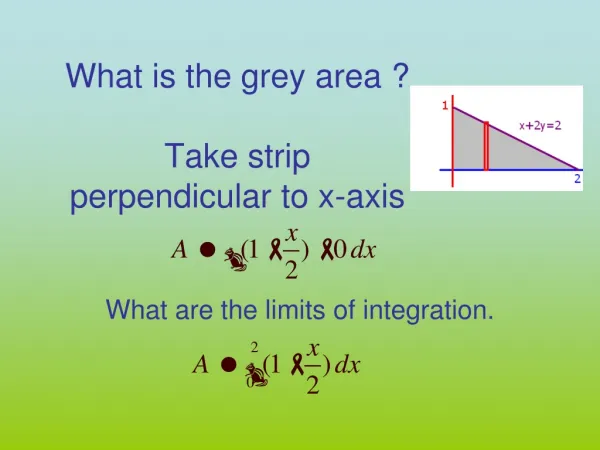
Goal Find the area between the graph and the x-axis
Area vs. Absolute Area Area of a rectangle = length*width or base*height Base 5, height 1 Area = 5 Absolute Area =5 Base 5, height -2 Area = -10 Absolute area= 10
Estimating Areas • Grid (boxes) • Rectangles • Trapezoids - Boxes- • Indivisibles
An Example to Understand the Techniques AREA BETWEEN A STRAIGHT LINE AND THE X-AXIS ON A CLOSED INTERVAL
Over/Underestimate Maximum Height Minimum Height Minimum height*Width<Area<Maximum Height*Width
Grid (Boxes) Make a grid. Estimate the number of rectangles needed to fill up the region Estimate area of one rectangle Area ≅ No Boxes*Area one box
Rectangles (Right/Left) Height at left hand points Height at right hand points
Left-Hand Sums Write the summation with 20 subdivisions and use calculator to find the sum.
Right-Hand Sums Write the summation with 20 subdivisions and use calculator to find the sum.
Trapezoid area of a trapezoid with heights A, B, and width C is given by (A+B)/2*C
Indivisibles Indivisible at each end point Average of all Indivisibles The area of the rectangle obtained above is approximated by calculating the Average value of the heights at the end points and multiply the average by the length of the interval.
The area between the graph of the continuous function y=f(x)and the x-axis on the interval [a ,b] is denoted
Exercise 2 Find an overestimate and underestimate for the Estimate the area using seven subdivisions a. Grid technique. b. Left-hand rectangles. c. Indivisibles. For questions (ii) (a-c), also write the expression using summation notation.
Exercise 3 i) Find and overestimate and lower estimate for the area. ii) Estimate the area using rectangles and twelve subdivisions (use summation notation and the calculator).
Find the area of the region and use it to determine the average distance between the car and CC for the whole length of the trip.