
ARP Bolt Fatigue

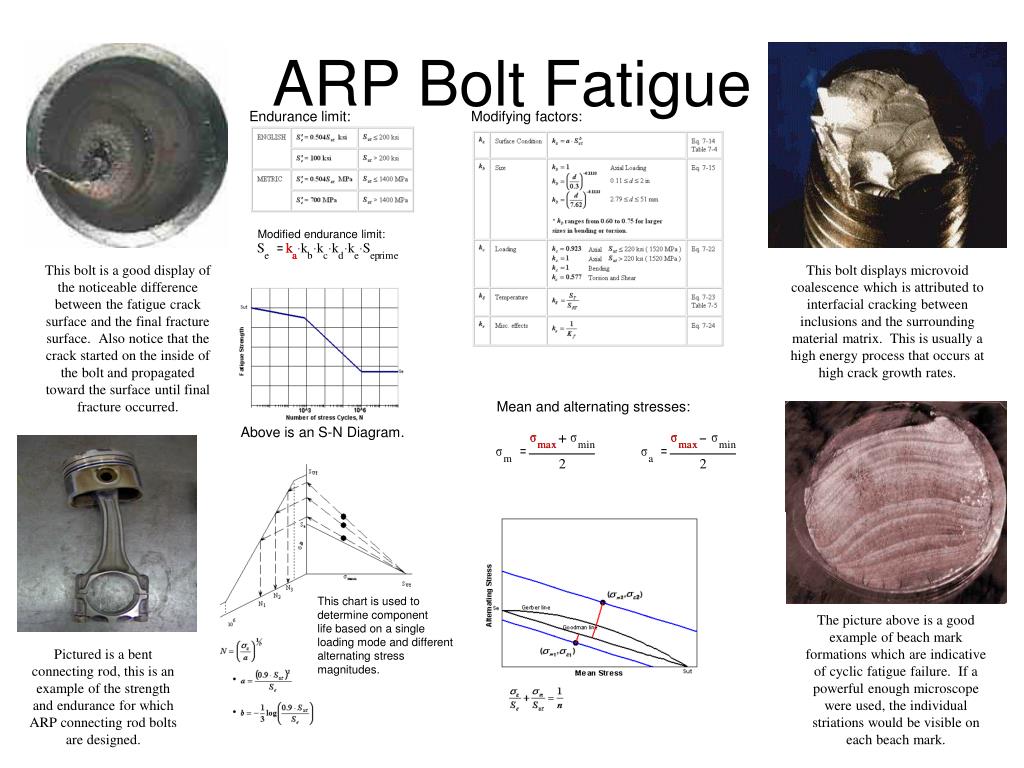
This document explores the fatigue characteristics of ARP connecting rod bolts, highlighting the differences between fatigue crack surfaces and final fracture surfaces. It examines the initiation of cracks from the bolt's interior and their propagation towards the surface, showcasing microvoid coalescence due to interfacial cracking. An S-N diagram is presented to relate component life to stress levels, along with examples of cyclic fatigue failure indicated by beach marks. The text emphasizes the design strength and endurance of ARP bolts in performance applications.
Télécharger la présentation 
Politique de téléchargement : le contenu du site vous est fourni TEL QUEL pour votre information et votre usage personnel ; il ne peut être vendu, concédé sous licence ni partagé sur d’autres sites sans l’accord de son auteur.Le contenu vous est fourni TEL QUEL, pour votre information et votre usage personnel uniquement. Téléchargez la présentation en cliquant sur ce lien. Lors du téléchargement, si vous ne parvenez pas à télécharger une présentation, l’éditeur a peut-être supprimé le fichier de son serveur.Pendant le téléchargement, si vous ne parvenez pas à obtenir une présentation, le fichier a peut-être été supprimé par l’éditeur.
F I N