US Isolationism vs. Interventionism: Prelude to WWII and the Impact of Pearl Harbor
Between 1935 and 1941, the US had a complex stance oscillating between isolationism and interventionism, influenced heavily by global events. Two significant points illustrate this shift: Firstly, President Roosevelt's embargo on vital resources for Japan in 1940 signaled escalating tensions. Secondly, the devastating attack on Pearl Harbor by Japan on December 7, 1941, catalyzed the US entry into WWII, transitioning it from a passive observer to an active participant in the Allied effort. This confrontation marked the end of isolationism, emphasizing the repercussions of militarism and imperial ambitions.

US Isolationism vs. Interventionism: Prelude to WWII and the Impact of Pearl Harbor
E N D
Presentation Transcript
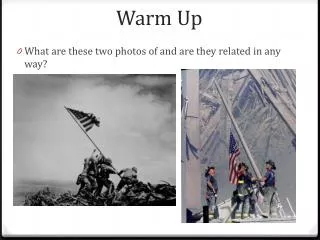
Warm-Up • Would you describe the attitude of the US at isolationist or interventionist from 1935-1941? Describe 2 points that helped you make your conclusion.
WWII Pearl Harbor, US Enters WW2
Japanese Militarism • Militarism leads to imperialism • 1940 FDR places embargo on resources • Coal, oil, iron, rubber • 1941 Tojo became PM of Japan • Peace in Pacific coming to an end
Pearl Harbor • Japan’s fleet • 6 aircraft carriers • 360 airplanes • Battleships, cruisers, destroyers and submarines • Goal • Destroy US naval and air ability in Pacific • Allow Japan to expand in Pacific
Pearl Harbor • Attack morning of Dec. 7, 1941 • Results • 8 battleships damaged- “battleship row” • 6 cruiser and destroyers destroyed • 288 airplanes damaged/destroyed • 2,500 dead • Aircraft carriers, subs untouched • Fuel and supply stores untouched
US Declares War • Dec. 8, 1941 • Allied Powers: USA, GB and USSR • Doolittle Raid – Bomb Tokyo (1942) Pearl Harbor Questions • What did the Japanese military leaders hope to achieve by attacking Pearl Harbor? Were they successful? (3 sentences) • Do you believe the US would have entered WW2 eventually IF the Pearl Harbor attack never happened? Explain. (5 sentences)
Mobilizing for War • Military 1941-1942 • Army: 1.2 to 4 M • Navy: 300K to 600K • Marines: 54K to 150K • Over 16 M Americans served in WW2
Minorities and Women • All ethnicities/races enlist to fight • Mexican & Native Am. integrated units • Af. Am. segregated units, support jobs • Women’s Army Corps (WAC) • 1943 • Clerical workers, truck drivers, lab techs • Women Nursing • At home and in combat
Mobilizing Industry • US #1 industrial country – will win the war • War Prod. Board (WPB) • Regulated resources & production • Office of War Mobilization (OWM) • Supervised all war production • Defense spending ends Great Depression
War Production • US companies focus on war production • 1944, US out produces all Axis Powers together. • Ford Motors – 8,000 B-24 bombers • Kaiser Shipping – Builds “Liberty Ships” in 4 days