Pollution in the GBR
120 likes | 244 Vues
Did you know that 22% of the world’s coral reefs are endangered by land-based pollution? In the Great Barrier Reef (GBR), 80% of adjacent land is farmland, contributing pollutants like copper that harm coral growth. Coastal reefs have suffered devastating impacts due to sediment runoff, dredging, and pollution, leading to a decline in biodiversity as thriving coral ecosystems are overtaken by mud and seaweed. With sediment flow into the GBR quadrupling and the looming threat of global warming, predictions suggest the reef could be nearly dead within the next 40 years.


Pollution in the GBR
E N D
Presentation Transcript
Pollution in the GBR Claire, Sofiah, Luna
22% of the world’s coral reefs are threatened by land-based pollution.
80% of the land that is adjacent to the Great Barrier Reef is farmland.
Pollutants such as copper has been known to interfere with the growth of coral polyps.
“Coastal reefs have been obliterated by runoff of sediment, dredging and pollution. Once thriving coral have been replaced by mud and seaweed.”-unknown
Toxins such as mercury, that gets into the ocean can kill almost all the organisms living on the reef and has a very negative affect on the reef itself.
The amount of sediment flowing into the GBR has quadrupled over the years.
Tourists overuse in natural resources has a very negative effect on the reef as well as it produces more waste and pollution.
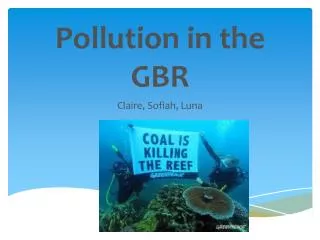
So what does this mean… With global warming increasing, and many forms of human influence still occurring, it is predicted that the Great Barrier Reef will be almost completely dead in 40 years!