Building Intelligible Infrastructure for Non-Expert Users in Digital Environments
As our dependence on networked computing systems grows, it's crucial to design infrastructure that is intelligible and manageable for non-expert users. This entails creating home network policies that respond to human activity, ensuring a strong and secure online presence, and emphasizing human-data interaction principles such as legibility, agency, and control. We must address the challenge of translating low-level technical behaviors into high-level user intents, enabling individuals to understand and manage their personal data and identities in both online and offline contexts.

Building Intelligible Infrastructure for Non-Expert Users in Digital Environments
E N D
Presentation Transcript
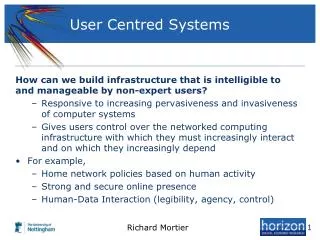
User Centred Systems How can we build infrastructure that is intelligible to and manageable by non-expert users? • Responsive to increasing pervasiveness and invasiveness of computer systems • Gives users control over the networked computing infrastructure with which they must increasingly interact and on which they increasingly depend • For example, • Home network policies based on human activity • Strong and secure online presence • Human-Data Interaction (legibility, agency, control) Richard Mortier
Ethical-by-Design Consider non-expert users in design of infrastructure A problem for Networking, Systems – and HCI, HDI • Legible Infrastructure • Hard to match low-level behaviour to high-level intent • What do we need to punch through the abstractions? • Personal Data • We generate data in (almost) everything we do • Can we understand and control it, and its implications? • Personal Clouds • On- and off-line worlds increasingly overlap • How can we move online without giving up our identities? Richard Mortier