Physics 12 Inclines
This document outlines key problems and experiments related to inclines in physics, focusing on equilibrium, forces, and motion. It involves calculating the necessary mass for equilibrium between two masses (m1 and m2) and exploring the dynamics of a roller coaster. The mass of the car and rider (700 kg) and the coefficient of friction (0.0500) are provided, with the task of determining the applied force to maintain constant speed and finding the speed at a different point on the track. A lab exercise for measuring static friction is also included.

Physics 12 Inclines
E N D
Presentation Transcript
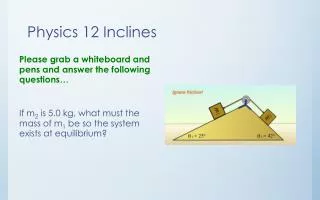
Physics 12 Inclines Please grab a whiteboard and pens and answer the following questions… If m2 is 5.0 kg, what must the mass of m1 be so the system exists at equilibrium?
Physics 12 Inclines Please grab a whiteboard and pens and answer the following questions… If m2 is 5.0 kg, what must the mass of m1 be so the system exists at equilibrium? Ans: 7.9 kg
A rollercoaster ride is shown in the diagram below. The mass of the car and rider is 700.0 kg and the coefficient of friction is 0.0500. (a) Determine the force that must be applied to the car as it is pulled up the hill at a constant speed of 1.00 m/s. (b) The car is released at point A with speed 1.00 m/s. Find the speed at point B.
A rollercoaster ride is shown in the diagram below. The mass of the car and rider is 700.0 kg and the coefficient of friction is 0.0500. (a) Determine the force that must be applied to the car as it is pulled up the hill at a constant speed of 1.00 m/s. Ans: 4.22 x 10³ N (b) The car is released at point A with speed 1.00 m/s. Find the speed at point B. Ans: 26.0 m/s
Inclines Lab • Finding Static Friction of an incline! • Please form a group of 2 to complete the following lab: • Hand in one completed lab report per pair • Due at the start of next class