

SlideServe
Menu
Préférences
© SlideServe · v2026

Computer Virus

omer avatar
5 diapositives · 559 Views · Mar 27, 2013

Computer Virus. Software programs written by someone that needs to get a life Can range from being a nuisance to causing major destruction and recovery time Software packages can be infected. Viruses Hide in:.
Computer Virus - slide 1
01 / 5Computer Virus
1 / 17

Télécharger la présentation

Computer Virus
Une image / un lien ci-dessous est fourni (tel quel) pour télécharger la présentation

Politique de téléchargement : le contenu du site vous est fourni TEL QUEL pour votre information et votre usage personnel ; il ne peut être vendu, concédé sous licence ni partagé sur d’autres sites sans l’accord de son auteur.Le contenu vous est fourni TEL QUEL, pour votre information et votre usage personnel uniquement. Téléchargez la présentation en cliquant sur ce lien. Lors du téléchargement, si vous ne parvenez pas à télécharger une présentation, l’éditeur a peut-être supprimé le fichier de son serveur.Pendant le téléchargement, si vous ne parvenez pas à obtenir une présentation, le fichier a peut-être été supprimé par l’éditeur.

F I N

Plus de contenu associé

Transcription de la présentation
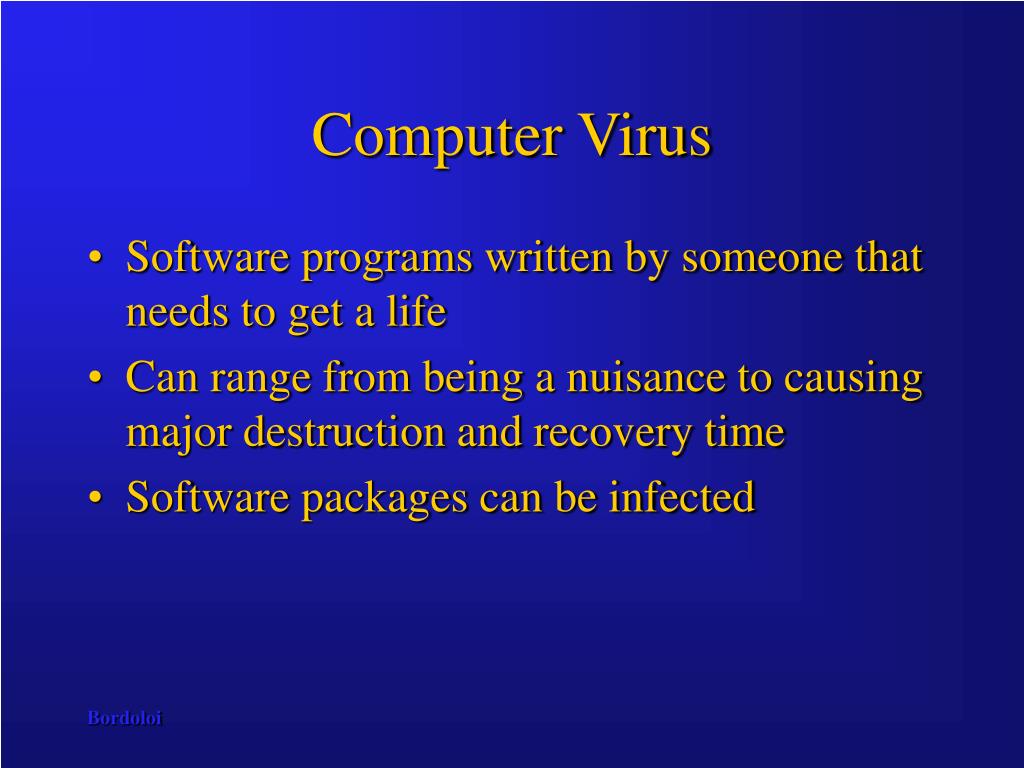
  1. Computer Virus • Software programs written by someone that needs to get a life • Can range from being a nuisance to causing major destruction and recovery time • Software packages can be infected

  2. Viruses Hide in: • Another computer program that executes so that the virus program can be placed into main memory. • Typically, viruses come from programs on floppy disks or networks. • Very complex viruses can write themselves in between hard disk sectors making them very difficult to detect.

  3. Virus Types • Trojan Horse - contained inside of another “host” program. Often date activated. White collar sabotage. • Worms - may not be an executable program itself but duplicates in main memory and hard disk space. Slows down the operating system. • Stealth virus - pretends to be another program that should be on the computer

  4. Virus Components: • Replication code - how it does what it does • Marker - set of codes that virus looks at to determine if the file has been infected • Kernel - code that controls task manipulation and replication • Overwriting vs non-overwriting: replaces an existing program file vs appending to it

  5. Elimination and Protection • Scanner software - “shield” software scans all data coming into a computer system looking for known or suspected viruses. Known viruses are detected by some recognizable “character string” in the virus computer code. Suspected viruses are detected whenever the virus program tries to do something weird, like attach to an existing program or reuse disk space reserved for the operating system. • Cleaner software - can try to restore infected files back to a useable state. Requires booting from a clean, write protected floppy disk May take a lot of time. • Detection software - detects the presence of a virus on an infected disk • Typical packages: McAfee, Dr. Solomon, etc