Download
1 / 3
30 likes | 166 Vues
The European research project "COLT" aimed to improve the service life and reliability of cold forging tools by addressing fatigue damage due to cyclic plasticity. In collaboration with partners across Europe, including ThyssenKrupp Presta and Böhler-Uddeholm, the project sought to enhance understanding of deterioration mechanisms and optimize process parameters. By innovating in steel making, tool manufacturing, and cold forging technologies, "COLT" aimed to significantly reduce production costs and increase tool longevity in the transport, mechanical, and electrical industries.

E N D
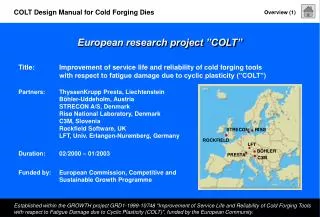
European research project ”COLT” Title: Improvement of service life and reliability of cold forging tools with respect to fatigue damage due to cyclic plasticity (”COLT”) Partners: ThyssenKrupp Presta, LiechtensteinBöhler-Uddeholm, Austria STRECON A/S, DenmarkRisø National Laboratory, DenmarkC3M, SloveniaRockfield Software, UKLFT, Univ. Erlangen-Nuremberg, Germany STRECON RISØ ROCKFIELD LFT BÖHLER Duration: 02/2000 – 01/2003 PRESTA C3M Funded by: European Commission, Competitive and Sustainable Growth Programme
European research project ”COLT” Title: Improvement of service life and reliability of cold forging tools with respect to fatigue damage due to cyclic plasticity (”COLT”) Motivation: Cold forging is the most efficient technology for mass production of high precision parts for transport, mechanical and electrical industries. There is a large potential for reducing the production costs in this industry by improving reliability of tools. The optimisation potential relies on enormous scatter of tool life which is currently encountered in the production. This is because cold forging tools operate under extreme conditions where slight variations in process load and material strength have a strong impact on tool failure. Cold forged parts
European research project ”COLT” Title: Improvement of service life and reliability of cold forging tools with respect to fatigue damage due to cyclic plasticity (”COLT”) Objective: The main objective of this project was to develop a methodology to increase tool life and to reduce its scatter. Key problems were related to fundamental understanding of the deterioration mechanisms, identification of stochastically relevant process parameters and introduction of such technological modifications in steel making, tool manufacturing and cold forging which leads to more economical production.