Download
1 / 7
70 likes | 214 Vues
Discover effective strategies to motivate learners by engaging them in authentic intellectual work. Understand the types of activities that account for 75% of student engagement in the classroom. Explore the authentic practices of real scientists, writers, and artists, and reflect on your own engaging experiences as a learner. Learn about Visible Thinking routines such as "Connect – Extend – Challenge" and the importance of uncovering and guiding students' thinking. Empower your classroom with methods that inspire and enrich student learning.

E N D
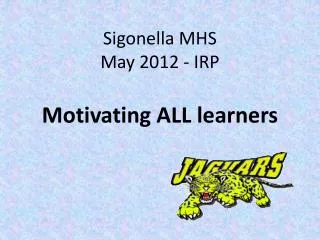
Sigonella MHS May 2012 - IRP Motivating ALL learners
What activities account for 75 percent of what students do in your classroom? • What kinds of activities are authentic to your discipline? In other words, what things do real scientists, writers, artists, etc. do? • What activities do you remember doing yourself that were highly engaging and really helped you understand a discipline? • How well do these match up?
“Students are motivated when they are engaging in authentic intellectual work. Teachers motivate students when they focus their efforts on uncovering and guiding students’ thinking.” Ritchhart, R., Church, M., and Morrison, K. (2011). Making Thinking Visible. San Francisco, CA: Jossey-Bass. http://wideworld.pz.harvard.edu/en/prog/visible.html
Engaging in Authentic Intellectual WorkWhat kinds of authentic intellectual work am I providing for my students?How can I find more time for engaging students in authentic intellectual work? What are my students learning about learning?
Uncovering and Guiding Students’ Thinking • Visible Thinking Routines http://www.pz.harvard.edu/vt/VisibleThinking_html_files/03_ThinkingRoutines/03c_CoreRoutines.html • Example 1: Connect – Extend – Challenge • Example 2: Generate - Sort – Connect - Elaborate • Example 3: Step Inside
The “Step Inside” Routine • Pretend to be one of the following types of student: • Student 1: High achieving, high motivated, compliant • Student 2: High achieving, low motivated, low compliance • Student 3: OK/moderate everything • Student 4: Low achieving, high motivated, compliant • Student 5: Low everything Imagine your classroom from this student’s perspective. Answer the following on a piece of paper. • What do you see or notice? • What do you believe or hold to be true? • What do you care deeply about? • What do you wonder about or question?
“Students are motivated when they are engaging in authenticintellectual work. Teachers motivate students when they focus their efforts on uncovering and guiding students’ thinking.” Ritchhart, R., Church, M., and Morrison, K. (2011). Making Thinking Visible. San Francisco, CA: Jossey-Bass. http://wideworld.pz.harvard.edu/en/prog/visible.html