Understanding Federalism: Powers and Clauses in the U.S. Constitution
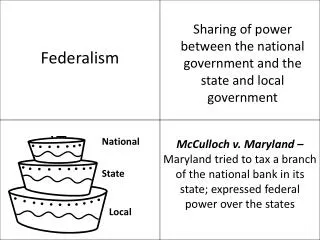
This chapter delves into the framework of federalism, highlighting the types of governmental powers: expressed, implied, and inherent. It discusses key concepts such as the Elastic Clause and the Necessary and Proper Clause, which allow for expanded federal authority. The Supremacy Clause is also covered, emphasizing federal law's precedence over state law. Important court cases like McCulloch v. Maryland illustrate these principles, along with essential terms like extradition, interstate compacts, and federal grants. This foundational understanding is crucial for grasping U.S. public policy dynamics.


Understanding Federalism: Powers and Clauses in the U.S. Constitution
E N D
Presentation Transcript
FEDERALISM CHAPTER 4
Delegated power • Expressed power • Implied power • Elastic clause • Necessary and Proper clause • Inherent power • Reserved power • Supremacy clause • Enabling Act • McCulloch v. Maryland • Extradite • Civil law • Privileges and Immunities • Extradition • Interstate compacts
Federal Grants • Preemption • Restraint • Mandate • Public policy • Sunset laws • Sunshine laws