Understanding Mutual Funds: Basics, Types, and Investment Strategies
Explore the essentials of mutual funds, including their history, types, costs, and investment strategies. This guide delves into the differences between open-end and closed-end funds, actively managed vs. index funds, and the importance of asset allocation. Learn about mutual fund fees, such as front-end and back-end loads, as well as no-load options. Understand how to evaluate mutual funds based on your investment objectives and the risks associated with them. Gain insights to effectively choose and purchase mutual funds.

Understanding Mutual Funds: Basics, Types, and Investment Strategies
E N D
Presentation Transcript
Mutual Funds Chapter Playlist Songs: “Money” by Pink Floyd –Live 8 “Money” by pink Floyd” – original video
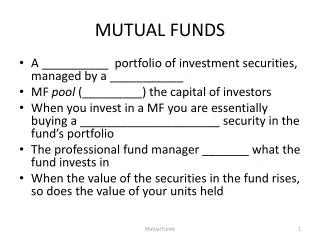
Mutual Fund Basics • Mutual fund: investment vehicle • Fund manager: Theperson or people responsible for • Closed-end mutual fund: A publicly traded mutual fund that raises capital • Open-end mutual fund: A mutual fund in which
History of Mutual Funds • 1893 – (closed-end) Boston Property and Trust • 1929 – Stock • 1980s – Open-end mutual funds • 2009 – Median investment in mutual funds by household = • Mutual funds are regulated by the
Costs and Fees of Mutual Funds • Front-end load: • Back-end load: • No-load mutual fund: • Net asset value (NAV): • Expense ratio:
Types of Mutual Funds • Actively Managed Mutual Fund • Professional fund managers trying to maximize the return on the fund and finding assets that meet the fund’s objective • Index Market Funds • Not actively managed
Types of Mutual Funds • Exchange-Traded Funds (ETFs) • Can be traded throughout the day on a stock exchange • Equity Mutual Funds • Stock mutual funds • Focus on a specific sector of the economy
Types of Mutual Funds • Bond Mutual Funds • Bond rating • Money Market Mutual Funds • Consists of short-term investments • Balanced Mutual Funds • Equity, bonds, and cash all in one fund
Dollar Cost Averaging vs. Continuous Automatic Investing • Specific dollar amount to be invested on a continual basis (e.g. $100/month) • No specified amount or end date • Specific dollar amount to invest (e.g.$10,000) • Divided into equal amounts over a specific time period (e.g. 10 months
Risk of Mutual Funds • Only as secure as the assets they hold • Watch the turnover rate
Costs and Classes of Mutual Funds • Fees • Front-end load (5%, would only have $95 of every $100 put into the fund) • Commissions • Share Classes • Class A, B, & C
Choosing and Buying a Mutual Fund • Know your investment objective • Research the funds • Fund’s investment objective • Principal risks of investing • Past performance
Choosing and Buying a Mutual Fund • If you feel uncomfortable managing your own investments, you might want to talk to a financial planner, financial adviser, stock broker, or local banker
Choosing and Buying a Mutual Fund • Open an account online with mutual find company • Look at requirements to open an account • Age • Discount broker • Scottrade, TD Ameritrade, e-Trade • Banks
Popular Online References • Morningstar (www.morningstar.com) • Yahoo Finance (http://finance.yahoo.com/) • Google Finance (www.google.com/finance) • Value Line (http://www.valueline.com/) • Wall Street Journal (www.wsj.com) • MSN Money (www.money.msn.com) • CNN Money (http://money.cnn.com)
Learn “A public-opinion poll is no substitute for thought.” ~Warren Buffet, Venture Capitalist (1930 -) • LO 12-1 Appreciate the history of mutual funds and understand mutual fund basics. • LO 12-2 Examine the types of mutual funds. • LO 12-3 Assess the benefits and risks of mutual funds. • LO 12-4 Evaluate mutual funds in terms of their class, commission, and fee structure. • LO 12-5 Plan how and where to invest in mutual funds.