1 / 42

Interactive Jeopardy: Mastering Story Elements and Literary Terms

Engage in a fun and educational game of Jeopardy focused on key concepts in storytelling and literature. Choose from various categories and answer questions based on their corresponding clues. Explore fundamental aspects such as plot, characters, setting, conflict, and themes, alongside literary devices like foreshadowing, tone, and mood. Whether you are a student or a literature enthusiast, this game is a perfect way to reinforce your understanding of narrative elements while enjoying a competitive classroom atmosphere.
onawa
Télécharger la présentation

Interactive Jeopardy: Mastering Story Elements and Literary Terms

An Image/Link below is provided (as is) to download presentation Download Policy: Content on the Website is provided to you AS IS for your information and personal use and may not be sold / licensed / shared on other websites without getting consent from its author. Content is provided to you AS IS for your information and personal use only. Download presentation by click this link. While downloading, if for some reason you are not able to download a presentation, the publisher may have deleted the file from their server. During download, if you can't get a presentation, the file might be deleted by the publisher.

E N D

Presentation Transcript


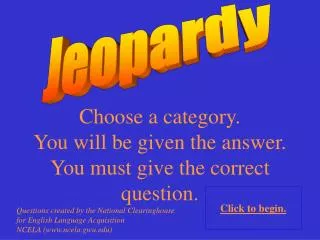
  1. Jeopardy Choose a category. You will be given the answer. You must give the correct question. Click to begin.

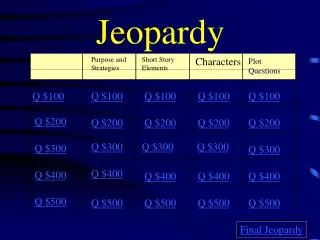
  2. Category A Category B Category C Category D Category E 10 Point 10 Point 10 Point 10 Point 10 Point 20 Points 20 Points 20 Points 20 Points 20 Points 30 Points 30 Points 30 Points 30 Points 30 Points 40 Points 40 Points 40 Points 40 Points 40 Points 50 Points 50 Points 50 Points 50 Points 50 Points

  3. Sequence of events that occur in a story.

  4. Plot

  5. Animals or people who complete action in a story.

  6. characters

  7. The person who is telling the story.

  8. Narrator

  9. The time and place of action in a story.

  10. Setting

  11. The struggle between 2 opposing forces (the problem)

  12. conflict

  13. The action builds and increases interest in the outcome of the story.

  14. Rising Action (or suspense)

  15. Lesson from the story that must be inferred or concluded by the reader

  16. Implied theme

  17. Lesson that the story teaches

  18. theme

  19. Lesson that is learned directly from the story.

  20. Stated theme

  21. Hints or clues of what’s to come in a story.

  22. foreshadowing

  23. Speech patterns that vary by region or generation.

  24. dialect

  25. Struggle between man and himself.

  26. Internal conflict

  27. Highest point of interest in a story-turning point.

  28. climax

  29. Struggle between opposing forces where man vs. man, man vs. society, man vs. nature

  30. External conflict

  31. The perspective that the narrator takes to tell the story—1st, 2nd, 3rd person

  32. Pt. of view

  33. When the opposite happens from what you expect; the difference between the way things seem and how they really are.

  34. irony

  35. The way an author’s attitude about the subject he’s writing about. ,

  36. tone

  37. How the conflict in a story is solved (the end).

  38. resolution

  39. Scene or incident that breaks the normal time order to show an event that happened earlier (in the past).
  40. Flash back

  41. The feeling that the reader gets from the story.

  42. Mood (or atmosphere)

More Related