Output fall
This analysis explores the significant output decline observed in several countries during key price liberalization periods, particularly in Russia and Ukraine. The paper discusses the interplay between aggregate demand and supply fluctuations, inefficient bargaining in production networks, and the impact of monopolistic behavior in newly liberalized markets. It emphasizes the importance of institutional frameworks, technological innovation, and network externalities in shaping economic outcomes following liberalization. It also critiques traditional economic models in understanding these transitions.


Output fall
E N D
Presentation Transcript
Output fall MA EITEI May 26th, 2009
Intro • In early transition accompanied by major output fall • This output falls coincided with price liberalization
Intro • Countries with Big Bang price liberalization clear pattern (PL, CZK, SK, RU, UKR) • Hungary gradual price liberalization, yet in 1991 dissolution of CMEA – international trading at world prices started • In RU and UKR ouptut fall already before price liberalization
Suggested explanations • Excess fall in aggregate demand due to stabilization policies • Problem: e.g. during biggest output fall, RU did not experience stabilization policies • Fall in aggregate supply – but how did it actually happen? One needs to know the mechanism, such a claim much too simple • Kornai (1993) – price liberalization induced changes in relative prices and contraction not accompanied by expansion
Formal models • Calvo and Coricelli (1994) – credit crunch hypothesis – stabilization policies led to high interest rates combined with hardening of budget constraints reduced output • Most likely not the whole story, again case of RU • Labor market frictions resulting from sectoral shifts – happen in other economies as well, also not too strong sectoral shifts directly after liberalization
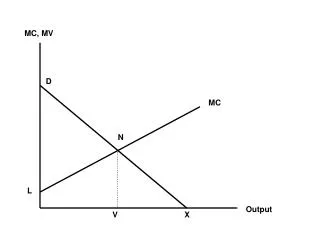
Formal models • Network externalities –Sussman and Zeira (1994), model with new language (technology) replacing the old one • Monopoly behavior of companies after liberalization – Central Planners behaving like vertically integrated monopoly, liberalization led to multiple monopolies charging monopoly prices to downstream industries
Ad Monopoly argument • Initially objections the argument valid only for closed economy, international competition forcing competitive behaviour • Also evidence for RU that industry concentration lower than originally believed • Yet low concentration might be consistent with regional (instead of national) monopolies • Hence pro-argument – it takes time invest into new technologies to compete on less narrow markets, until then, monopolies might indeed be present
Disorganization effects of liberalization • Do not assume pre-existence of markets or their instantaneous creation • Helps understand how new markets emerge • Traditional models not appropriate – assume institutional basis, communication channels, information network already exist
Ad Disorganization effects • 2 models presented (both in Economics of Transition, Chapter 8, by Gerard Roland) • Model with inefficient bargaining and complementarities • Model with costly search and asset specificity
Ad Inefficient bargaining and complementarities • Liberalization induces disorganization of existing production links due to inefficient bargaining • Inefficient bargaining in turn due to lacking contracting institutions • In case these institutions were present, present production links would keep existing • Disorganization of production links accompanied by output fall
Blanchard and Kremer (1997) • Assume SOE needs n inputs to produce n outputs • Strong complementarities -> if even 1 input is missing, zero output • Each input provided by single supplier having alternative use of input for h • Suppliers distributed uniformly on [0,h*] with c.d.f. such that F(0)=0 and F(h*)=1 • h private information of supplier
Taske-it-or-leave offer given to each supplier of a price p by SOE • All suppliers identical ex ante, i.e. all offered the same price • If p=h*, production takes place for sure, suppliers getting rents h*-h • Yet if h*>1, net profits of SOE are n(1-h*)<0
Hence SOE might prefer to trade-off lower offer of p (and higher expected profits) against positive probability of disruption • Outcome – total output a function of h* and n • For intermediate values of h* output fall • The output fall happens due to ineficient bargaining • If efficient, in principle possible to pay to those having p<h compensation by others having p>h • In such a case joint surplus wuld have been higher – suppliers i with p<h(i) would have p+ε(i)=h(i), suppliers i with p>h(i) would have p-µ>h(i)
Changes in n (number of suppliers) • Also as n increases output falls more pronounced • Extreme case as n -> infinity, p->1 and see the figure
Interpretation of n • Captures complexity of production • Ceteris paribus the higher the complexity, the higher the output fall -> less developed countries should experience lower output fall (China)
Remember two key assumptions • Asymmetric information (and resulting inefficient bargaining) • SOE might possibly contract the outside option upon verification plus ε, which benefits supplier • Yet verification difficult, especially when legal system weak and underdeveloped • This was likely the case of transition economies right after price liberalization • Technological complementarities
Search frictions and specific investment • Roland and Verdier (1999a) • Inefficient bargaining not necessary for output fall • Liberalization means freedom of contracting • Price theory in this context not appropriate • Contract theory more convenient
Contrary to common job search models, existing production links are preserved during search • When a new match is found, existing production links break up
Key assumption – investment into relationship is relationship-specific • Specific investments severe the hold-up problem and reduce the ex-ante willingness to enter a relationship • Hence these investments are done only after a new long-term partner has been found
In other words, if agent plans to search one more period, it is not profitable for her to invest while searching • here output fall due to failure of enterprises to replace obsolete capital and a fall in investment demand
Main story of the model • agents searching at least one more period will not invest • Aggregate output might fall as a result due to fall in investment demand • Note capital market imperfections a la Calvo and Coricelli (1994) not needed as well as bargaining inefficiencies
Assumptions • Two sectors – consumption and investment goods sector • Endogenized outside options – two-sided matching n • In consumption sector, output depends on match quality • No search before liberalization • Random matching of H types • Relationship-specific investment – zero value if match splits + match has to be long-term for investment to be profitable • 2 periods assumed only
All search equilibrium • All agents search in period 1 and all agents search in period 2 except of H types that already formed HH pairs • For model solution see handouts
Ad negative externalities of the model -> lack of investment given search efforts (individually it is always better to search for H type) AND specificity • If no investment specificity (e.g. no investment necessary at all) -> socially costless search (present production preserved)
Evidence on Blanchard and Kremer (1997) • Konings and Walsh (1999) • 300 Ukrainian firms • Complexity of production (measured by # of major products produced) matters, but only for traditional firms and not for de novo firms