Download

1 / 13
130 likes | 237 Vues
This text offers a detailed examination of Puritan life in America, focusing on their quest for religious freedom and the establishment of a theocratic society. It discusses the rigid beliefs of the Puritans, their approach to witchcraft, and the notorious Salem Witch Trials of 1692. The text also connects historical events to Arthur Miller's "The Crucible," highlighting parallels with the Red Scare and McCarthyism. Through this lens, the narrative reveals how fear and societal control shaped both the historical context and Miller's critique of American society.

E N D
Historical Introduction toThe Crucible Miss Glass 1 February 2011
Puritan Life In America Sought religious freedom • Separate from Church of England Theocracy: a union of church and state. Puritan Beliefs: • Predestined for heaven • Rigid rules and beliefs • To be different meant to be controlled by evil • Preached “fire and brimstone” • threatening punishment in the hereafter
Salem, Massachusetts • Northeast of Boston • Established: 1626 • Salem means “City of Peace” • Roger Conant and John Endicott
1692 Salem History • A Great Divide • Salem Town: wealthy merchants; trade with London • Salem Village: poor farmers wanted independence • Salem Village divisions • Merchants vs. Farmers • Reverend Samuel Parris
A History of Witch Hunts • Definition of “witch” in the 17th Century • One who had made a pact with the devil (the Christian embodiment of evil) by exchanging soul for evil powers • Sin because denied God’s superiority • 16th and 17th century Europe: 1-9 million accused and executed • Practiced surviving folk customs from Pre-Christian times • Viewed as “heresy” http://www2.iath.virginia.edu/salem/bcr/salem/salem.html
A History of Witch Hunts • 1484: Pope Innocent VIII, Germany • Casting spells to destroy crops & abort infants • 1500-1660: Reformation in Europe • 50,000-80,000 suspected witches executed. • 1536: Henry VIII of England • Accused Anne Boleyn, of witchcraft • 1591: James I of England • Largest witch hunt in British history
Salem Witchcraft Trials, 1692 • How did it all begin? • Minister’s daughter and other girls were affected by seizures and fits of unconsciousness • No medical explanation • Tituba, Sarah Good, And Sarah Osburne named as witches • Tituba admitted to witchcraft • Girls continued to accuse • No proof other than someone’s accusation was required • Must admit to witchcraft, repent, and name associates • In the end, 20 people executed and at least 150 jailed
Connect to Communism • Un-American Activities Committee (HUAC) • Investigated un-American & subversive activities • Late 1940s-1950s known as the “Red Scare” • Heightened fear of Communist influence on American institutions and espionage by Soviet agents • Senator Joseph McCarthy from Wisconsin • Claimed 200 Communists had infiltrated the US government
McCarthy Investigations • McCarthy led investigations • Mostly government employees, union members, writers, and entertainers • 320 artists placed on blacklist, which ended their careers • Hollywood Blacklist: “We will not knowingly employ a Communist or a member of any party or group which advocates the overthrow of the government of the United States” • Must name other members of the party in order to prove abandoned left-wing views
McCarthy’s Downfall • McCarthy began televised hearings into Communists in the US Army • “McCarthy has shown himself to be evil and unmatched in malice.” • McCarthy’s actions condemned December 2, 1954 • “Red Scare” hysteria calmed down
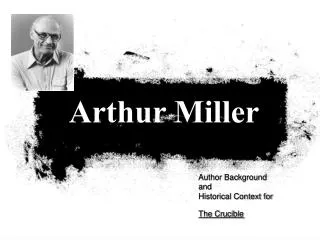
Arthur Miller • Born 1915 in NY • 1932: Graduate from Lincoln HS • Took two years to earn money for tuition • 1934: Enroll at University of Michigan • Began writing drama in college • 1947: All My Sons opened on Broadway • 1949: Won Pulitzer Prize for Death of a Salesman • 1953: The Crucible
Repercussions of The Crucible • After The Crucible, Miller was investigated for possible associations with the Communist Party • 1956: Married Marilyn Monroe • Marriage lasted 5 years • 1956: Called to testify before the House Committee on Un-American Activities • Never joined Communist party but advocated social justice and equality • Refused to discuss associates • Found in contempt of Congress