Download
1 / 16
160 likes | 281 Vues
Prepare for the upcoming Thermodynamics and Kinetics exam scheduled on March 15, 7:00-9:00 PM at 103 Mumford Hall. This guide covers essential thermodynamic concepts such as the spontaneity of reactions, Gibbs free energy (ΔG), enthalpy (ΔH), and entropy (ΔS). Additionally, it addresses reaction kinetics, including rate laws, mechanisms, and factors affecting reaction rates. Review the equations and principles vital for understanding spontaneity and reaction rates to excel in your exam.

E N D
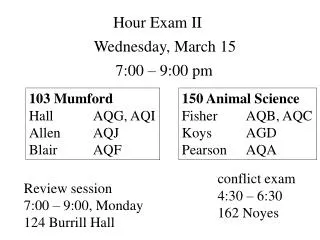
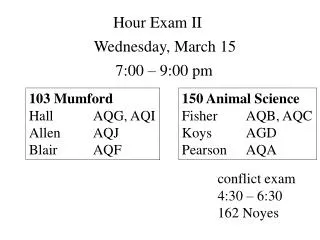
Hour Exam II Wednesday, March 15 7:00 – 9:00 pm 103 Mumford Hall AQG, AQI Allen AQJ Blair AQF 150 Animal Science Fisher AQB, AQC Koys AGD Pearson AQA conflict exam 4:30 – 6:30 162 Noyes
Kinetics Thermodynamics : spontaneity of reaction G < 0spontaneous 2H2(g) +O2(g) 2H2O(l) Go = -474 kJ Go = Ho- TSo a) low T b) high T Ho < 0 favorable So < 0 unfavorable Thermodynamically spontaneous very slow
thermodynamics thermodynamics Kinetics rates of reaction mechanism of reaction O2(g) 2 H2O(l) Greaction < 0 2 H2(g) + Greactants Gproducts kinetics
qn qe r + + Kinetics 2H2(g) + O2(g)2 H2O(l) Go = -474 kJ spontaneous P.E.n-e - +
+ + High Temperature exothermic endothermic
Kinetics rate of reaction [reactant] decrease increase [product] 1. Temperature (K.E.) 2. Concentration 3. Orientation
- 1 2 differential rate laws A + B C - d[A] = d[C] dt d[B] = dt a) + b) - + rate = dt A + B 2 C - d[A] = dt d[C] dt -d[B] = dt rate = A + B C +
100 [ ] 50 0 1 2 3 4 5 time (min) [ ] = t -[ ] = t x t (min) 0 100 100 0 x 72 1 72 28 x 2 52 52 48 x x 3 37 37 63 x 4 27 27 73 5 19 19 81 81 - 0 = 16.2 min-1 ave. rate = 5 - 0 (19 ) - 100 ave. rate = - = 16.2 min-1 5 - 0
x 100 t (min) 0 100 100 0 x [ ] 72 1 72 28 x 50 2 52 52 48 x x 3 37 37 63 x 4 27 27 73 0 5 19 19 81 1 2 3 4 5 time (min) overall ave. rate = - (19 - 100) = 16.2 min-1 5 - 0 1st minute ave. rate = = 28.0 min-1 - (72 ) - 100 1 - 0 5th minute ave. rate = - 27) = 8.0 min-1 - (19 5 - 4
x 100 x [ ] x 50 x x x 0 1 2 3 4 5 time (min) instantaneous rate slope of line tangent to curve = at t = 0 initial rate fastest rate
t instantaneous (min) rate k = rate [reactant] 100 33.0 0 0.33 1 72 23.8 2 52 17.2 3 37 12.2 4 27 8.9 5 19 6.3 0.33 0.33 0.33 0.33 0.33 rate [reactant] = k [reactant] k = rate constant
k = rate [reactant] k independent of [reactants] dependent on Temperature k [A]a [B]b [C]c ... (-d[A]) k rate = = dt k, a, b and c determined experimentally isolation method
[A] [A] Concentration (M) Concentration (M) t (ms) t (ms) Exp. 1 [B]i initial rate [A]i (M) (M) (M s-1) 1.0 1.0 1.0 x 10⁻³ Exp. 2 [A]i [B]I initial rate (M)(M)(M s-1) 2.0 1.0 2.0 x 10⁻³ Exp. 3 [A]i [B]I initial rate (M)(M)(M s-1) 1.0 x 10⁻³ 1.0 2.0
Exp. 1 k rate = [A]a [B]b [A]i [B]I initial rate (M)(M)(M s-1) 1.0 1.0 a = 0 a = 1 a = 2 2 x 10-3 = 1 x 10⁻³ [2.0]a [1.0]a rate 2 = rate 1 1.0 x 10⁻³ Exp. 2 1 x 10-3 = 1 x 10⁻³ rate 3 = rate 1 [2.0]b [1.0]b b = 0 b = 1 b = 2 [A]i [B]I initial rate (M)(M)(M s-1) 2.0 1.0 rate = k [A] 2.0 x 10⁻³ 1storder reaction Exp. 3 [A]i [B]I initial rate (M)(M)(M s-1) 1.0 2.0 1x10⁻³(M s-1) = k [1.0 M] k = 1 x 10⁻³ s-1 1.0 x 10⁻³