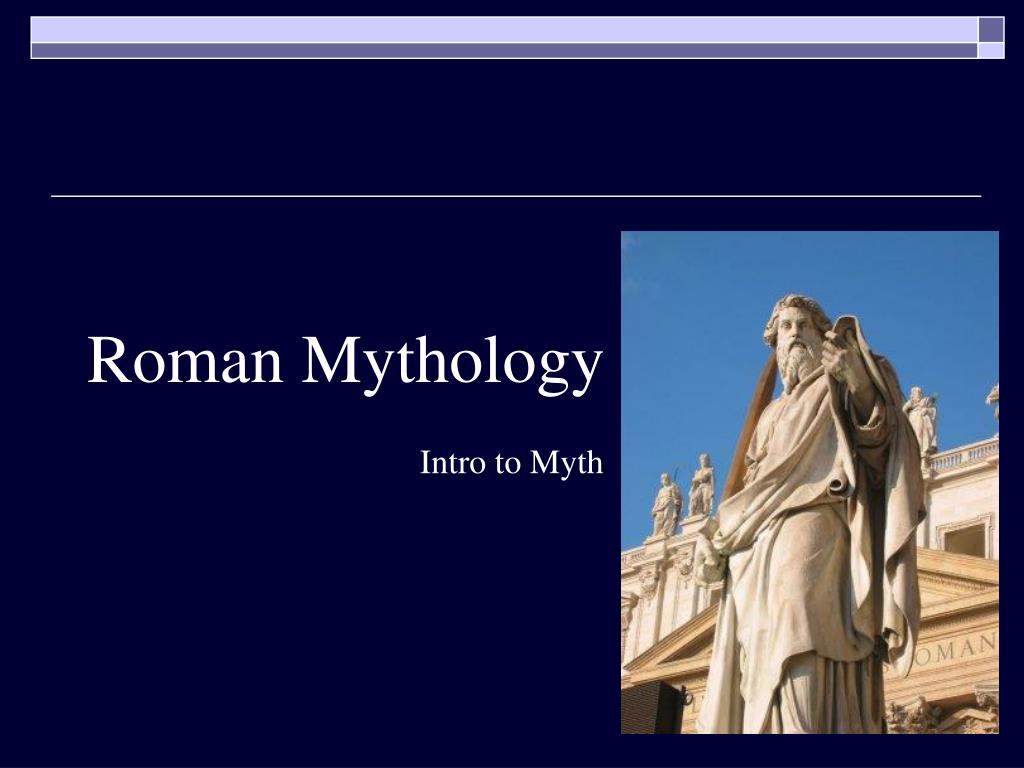
Roman Mythology Intro to Myth
Roman Mythology • Romans adopted the Greek gods and stories because they had few stories of their own • They also adopted gods from other cultures, such as Egypt • The characteristics of the Greek gods changed somewhat as Roman gods • For example, Mars (Ares) was much more popular and respected with the Romans
Zeus Hera Jupiter/Jove (vocab: jovial) Juno The Gods = =
Poseidon Hades Demeter Hestia Aphrodite Neptune Pluto/Dis (vocab: plutocratic) Ceres (vocab: cereal) Vesta Venus (vocab: venereal) The Gods, con’t = = = = =
The Gods, con’t • Athena • Hephaestus • Apollo • Minerva/Pallas/Athene • Vulcan (vocab: volcano) • Apollo/Phoebus = = =
The Gods, con’t • Artemis • Ares • Dionysus • Hermes • Diana • Mars (vocab: martial) • Bacchus (vocab: bacchanalian) • Mercury (vocab: mercurial) = = = =
Minor Roman Gods • Flora: goddess of plants (vocab: flora) • Fauna: goddess of animals (vocab: fauna) • Aurora: goddess of the dawn (vocab: auroral) • Cupid: Venus’s son; makes people fall in love (vocab: cupidity) • Somnus: god of sleep (vocab: somnambulate) • Maia: goddess of growth • Morpheus: god of dreams (vocab: morphine) • Saturn: Latin name for the Titan Cronus
The Origin of the Months • January = Janus • February = Roman festival of Februs • March = Mars • April = unknown • May = Maia • June = Juno • July = Julius Caesar’s birth month • August = Augustus Caesar’s lucky month • September = Septem (7) • October = Octo (8) • Novemeber = Novem (9) • December = Decern (10)
Roman Religion • Romans believed the world was full of numina, spirits, that could influence humans • Rituals were performed to keep these spirits happy and gain favor from them • Roman religion was very home based • The head of the household was responsible for performing rituals, etc.
Roman Religion, Cont. • Because of the importance of the home, there were some differences between the Greek and Roman gods • Vesta (Hestia) was much more important • Janus was a double-faced god of doorways who kept evil out of the home • Manes, spirits of dead ancestors, were thought to protect the home
The Mythical Founding of Rome • In Roman mythology Romulus and Remus were the twin sons of Mars and the founders of the city of Rome. • Their mother, Rhea Silvia, was the only daughter of King Numitor of Alba Longa. • Numitor's brother Amulius seized the throne and forced Rhea Silvia to become a Vestal Virgin. • He wanted to make sure that she had no children who would have a claim to the throne. • However, Rhea Silvia was raped by Mars and gave birth to Romulus and Remus.
When Amulius found out about the twins, he ordered that they be thrown into the Tiber River to drown. • The boys floated downstream, coming ashore near a sacred fig tree. • A she-wolf and a woodpecker—creatures sacred to Mars—fed the twins and kept them alive until a shepherd found them. • Faustulus, the shepherd, and his wife raised the boys. • They grew up to be brave and bold.
The twins became involved in local conflicts and led a group of youths on raids, including a raid on a herd of cattle that belonged to Numitor. • Remus was caught and brought before Numitor. • In questioning the young man, Numitor realized that Remus was his grandson. • Shortly afterward, the twins led a revolt against Amulius in which they killed him and put Numitor back on the throne.
Romulus and Remus wanted to found a city of their own, so they returned to the place where Faustulus had discovered them. • An omen determined that Romulus should be the founder of the new city. • He marked out the city boundaries and began to build a city wall. • When Remus jumped over the unfinished wall, mocking his brother for thinking that it could keep anyone out of the city, Romulus killed him. • Romulus became the sole leader of the new city, named Rome.
To populate Rome, Romulus invited people who had fled from nearby areas to live there. • However, most of these settlers were men. The city needed women. • Romulus invited the Sabine people, who lived in neighboring towns, to come to Rome for a great festival. • While the Sabine men were enjoying themselves, the Romans seized the Sabine maidens, drove the men from the city, and married their women. • The event became known as The Rape of the Sabine Women.
The Sabine men planned revenge and staged several small but unsuccessful raids. • Then Titus Tatius, the Sabine king, led an army against Rome. • The Romans were losing the battle when Romulus prayed to Jupiter for help. • At that point, the Sabine women stepped in. • They pleaded with the warring men to stop, for they could not bear to see their fathers and husbands killing one another. • The two sides agreed to a peace in which the Sabines and Romans formed a union, with Rome as the capital.
Virgil • Virgil wrote the Aeneid • Based on the Iliad • Written from 29-19 B.C. • Written to praise Augustus Caesar and the greatness of Rome
Ovid • Famous Roman poet • Lived from 43 B.C. to 17 A.D. • Most famous work is the Metamorphoses • Was banned from Rome for his offensive writings • Much of Ovid’s work has been redone • For example, Romeo and Juliet is based on Ovid’s “Pyramus and Thisbe”