Carbon and the Forest
This comprehensive overview explores the relationship between carbon, forests, and climate change. It defines carbon, the carbon cycle, and highlights the role of elevated atmospheric CO2 in climate dynamics. Discover effective strategies for reducing atmospheric CO2, including forest carbon sequestration and avoided emissions. Through interactive exercises such as the "Six Bits Puzzle," students will learn about the importance of carbon storage in trees and wood products over multiple harvests. Engaging in this exploration will enhance understanding of carbon management and the significant co-benefits forests provide for climate mitigation.
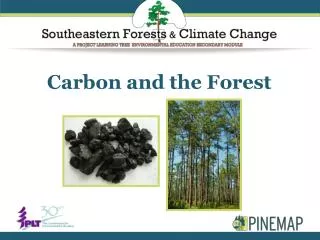

Carbon and the Forest
E N D
Presentation Transcript
What has carbon? You!
Atmospheric CO2 1 petagram = 2.2 trillion pounds
How do we reduce elevated atmospheric CO2? Make this smaller Make this smaller Make this bigger Make this bigger
How do our options for reducing atmospheric CO2 compare? • Biggest factor • “Easy” to control and track, especially for point sources • In some cases “large” economic cost, but in some cases large economic benefits • Subject to disturbance reversals • Harder to track • We already have the technology • Generally large “co-benefits” We don’t have much experience managing ocean biogeochemistry
Solve the Six Bits Puzzle • Each group of six students will have a set of six cards. Distribute them so each person has one. • On one card is a question. • Use the information on every card to answer the question. • You can not show anyone your card!
How do we reduce elevated atmospheric CO2? Make this smaller Make this bigger Avoided Emissions or Substitution Forest C Sequestration
Carbon Stored in Live Trees 1st harvest 2nd harvest 3rd harvest
Carbon Stored in Dead Wood 1st harvest 2nd harvest 3rd harvest
Carbon Stored in Short-lived Wood Products 1st harvest 2nd harvest 3rd harvest
Carbon Stored in Long-lived Wood Products Wood from 1st harvest has decomposed 3rd harvest 2nd harvest 1st harvest
Carbon Saved by Not Using Carbon-intensive Products 3rd harvest 2nd harvest 1st harvest
Forest Pool 1st harvest 2nd harvest 3rd harvest Forest
Forest + Dead Wood Pool 1st harvest 2nd harvest 3rd harvest Dead wood Forest
Forest + Dead Wood + Short-lived Products Pools 1st harvest 2nd harvest 3rd harvest Short-lived products Dead wood Forest
Forest + Dead Wood + Short-lived Products + Long-lived Products Pool Wood from 1st harvest has decomposed 2nd harvest 1st harvest 3rd harvest Long-lived products Short-lived products Dead wood Forest
Forest + Dead Wood + Short-lived Products + Long-lived Products + Carbon Saved Pool Wood from 1st harvest has decomposed 3rd harvest 2nd harvest 1st harvest Carbon saved Long-lived products Short-lived products Dead wood Forest
Figure from CORRIM Fact Sheet: Maximizing Forest Contributions to Carbon Mitigation (2009)