Download
1 / 33
330 likes | 457 Vues
This chapter explores the various electrophilic reactions that occur at the nitrogen and carbon atoms of purines, highlighting the influence of substituents and reaction conditions on alkylation and acylation selectivity. It discusses the stability of reaction products, the role of sterics in N7/N9 positioning, and the dynamics of reversible reactions. The chapter also examines the synthesis of bioactive purines, key strategies such as carbonyl condensation, and the potential for anticancer and antiviral applications. Additionally, it addresses natural products related to diterpenes and plant growth hormones.

E N D
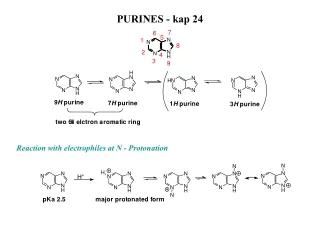
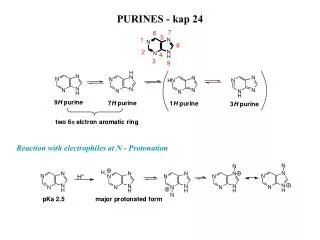
PURINES - kap 24 Reaction with electrophiles at N - Protonation
Reaction with electrophiles at N - Alkylation Selectivity depends on substituents and conditions
N7/N9: - Sterical factors (Large 6-subst) Termodyn. control (reversible react.) Electrophiles - cancer
Reaction with electrophiles at N - Acylation / Sulfonation Acylation products generally unstable Sulfonation - Stable prod., selective N9 Reaction with electrophiles at N - oxidation
Reaction with electrophiles at C E-fil Ar subst, generally not working Reaction with nucleophiles
Nu.Ar.Subst: Reactivity F>Cl>Br>I Other leaving groups
Oxy purines -Oxo forms Alkylation, acylation etc
Replacement of O with other hetero atoms Amino purines Amino form
Alkylation, acylation etc Diazotation etc.
Synthesis of Purines Carbonyl condensations Strategy A - Traube synth. etc
Carbonyl condensations Strategy B Cycloadditions
Bioactive Purines DNA / RNA bases Anticancer / antiviral drugs
Adenosin og adenosinreseptorligander Sel. A2A antag. Parkinston /Alsheimer? AKB PhD-lecture, august 05 Cytokinins - Plant growth hormones
Natural products • Heteromines • Isolated from Heterostemma brownii • Treatment of tumors in Taiwanese folk medicine Agelasines from marine sponges (Agelas spp) Asmarines for marine sponges Agelasine D
Reversine http://www.scripps.edu/news/press/122203.html
Heterocycles cont. more than 2 heteroatoms in one ring kap 26 5-membered rings Triazoles and tetrazoles 6-membered rings Triazines and tetrazines
5-membered rings Triazoles and tetrazoles (pentazoles highly unstable) More acidic - less basic comp to diazoles Bioisostere - CO2H
1,2,3-Triazole React. at N
React. at C 1,2,3-Triazole
React. at N 1,2,4-Triazole React. at C
Small diff. stab. taut. Tetrazole Bioisostere - CO2H React. at N
Oxadiazoles and thiadiazoles (thiatriazole) - No acidic NH -Generally low basicity (cf triazoles) -Some examles N-quart. -Few ex. Introd of E-fils on C -Prone to Nu attack Aromaticity (NMR shifts, bond lenghts)
Ring opening (esp. O-cont. rings) C-lithiation easy, but often low stab of lithiated prod
6-membered rings Triazines and tetrazines Highly activated for Nu attack No simple react with electrophiles
Diels Alder react. Leading to azines with fewer N (see synth of pyridines, diazines)