Exploring High-Dimensional Chaos: Lorenz and Duffing Systems - IASTED Workshop Montreal 2007
310 likes | 435 Vues
This tutorial equipped attendees with the knowledge to construct high-dimensional Lorenz and Duffing systems while studying high-dimensional chaos (HDC). Key topics included the dynamics of various models, such as the transition from 3D to 8D Lorenz systems, energy conservation, chaotic transients, and modes selection. The workshop emphasized the uniqueness of routes to chaos in higher dimensions, exemplified through case studies, including Rayleigh-Benard convection models. Participants learned about the critical role of dimensionality in understanding complex chaotic behaviors.


Exploring High-Dimensional Chaos: Lorenz and Duffing Systems - IASTED Workshop Montreal 2007
E N D
Presentation Transcript
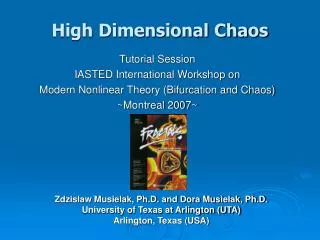
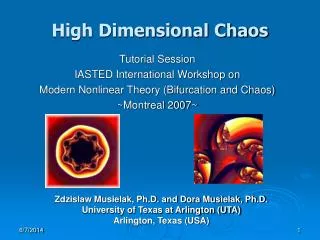
High Dimensional Chaos Tutorial Session IASTED International Workshop on Modern Nonlinear Theory (Bifurcation and Chaos) ~Montreal 2007~ Zdzislaw Musielak, Ph.D. and Dora Musielak, Ph.D. University of Texas at Arlington (UTA) Arlington, Texas (USA)
Lecture 2 Objective: Construct high-dimensional Lorenz and Duffing systems and study high-dimensional chaos (HDC). • High-dimensional Lorenz models • HDC in these models • High-dimensional Duffing systems • HDC in these systems • Summary
2D Rayleigh-Benard Convection Model Continuity equation for an incompressible fluid Navier-Stokes equation with constant viscosity Heat transfer equation with constant thermal conductivity Saltzman (1962)
Saltzman’s Equations = stream function = temperature changes due to convection = Prandtl number = coefficient of thermal diffusivity = Rayleigh number
Fourier Expansions where and are horizontal and vertical modes, respectively
Fourier Expansions where and are horizontal and vertical modes, respectively
Criteria for Mode Selection • Selected modes must lead to equations that • have bounded solutions (Curry 1978, 1979) 2. Selected modes must lead to a system that conserves energy in the dissipationless limit (Treve & Manley 1982; Thiffeault & Horton 1996; Roy & Musielak 2006)
From 3D to 5D Lorenz Models Lorenz minimal truncation: Resulting 3D Lorenz model has bounded solutions and conserves energy in dissipationless limit 4D model with - uncoupled ! 5D model with and - uncoupled !
6D Lorenz Models I Selected modes (Humi 2004): r = 28.45 System does not conserve energy in dissipationless limit !!! Route to chaos – period-doubling (?)
6D Lorenz Models II Selected modes (Kennamer 1995): r = 38 System does conserve energy in dissipationless limit Route to chaos – chaotic transients Musielak et al. (2005)
6D and 7D Lorenz Models Howard & Krishnamurti (1986) developed a 6D Lorenz model that included a shear flow Thiffeault & Horton (1996) showed that this 6D model does not conserve energy in the dissipationless limit To construct an energy conserving system, Thiffeault & Horton had to add another mode and develop a 7D Lorenz model
8D Lorenz Model Selected Fourier modes: 3D system 5D system 8D system Roy & Musielak (2007)
Energy Conservation Thieffault & Horton (1996)
Phase portraits r = 26.5 3D Lorenz System r = 38.5 8D System
Power spectra 8D system r = 28.50 r = 29.25 r = 35.10 r = 38.50
Lyapunov Exponents 8D System Onset of chaos at r = 36
Route to Chaos in 8D Model Ruelle & Takens (1971) Quasi-periodicity is route to chaos for 8D system, which is different than chaotic transients observed in 3D Lorenz model
Other Lorenz Models 14D Lorenz model (Curry 1978) Decay of two-tori leads to a strange attractor that is similar as the Lorenz strange attractor Model does not conserve energy in dissipationless limit 5D Lorenz model (Chen & Price 2006) A profile of the strange attractor in this model is similar to the Rayleigh-Benard convection problem in a plane fluid motion – Fourier modes describing shear flows are Included!
SUMMARY • Neither 4D nor 5D Lorenz models can be constructed. • Unphysical 6D–14D Lorenz models that do not conserve energy in the dissipationless limit have been constructed; chaotic transients, period-doubling and quasi-periodicity were identified as routes to chaos in these systems. • The lowest-order, high-dimensional (HD) Lorenz model that conserves energy in the dissipationless limit is an 8D model and its route to chaos is quasi-periodicity. • Since the strange attractor of the 8D systems has high dimension, the chaotic behavior observed in this system represents high-dimensional chaos (HDC).
Coupled Duffing Oscillators Systems considered: Symmetric systems (2, 4 and 6-coupled oscillators) Asymmetric systems (3 and 5-coupled oscillators) D. Musielak, Z. Musielak & J. Benner (2005)
2-Coupled Duffing Oscillators II Chaos: B = 14.5 – 19.0 B = 23 – 25.5 Ueda et al (1979, 1980) Lyapunov exponents Original Duffing system has 8 regions that exhibit chaos
2-Coupled Duffing Oscillators II B = 24 B = 19 Routes to chaos: Period – Doubling and Crisis
4-Coupled Duffing Systems I Torus at B = 86 B = 40.5 – 42 (period-doubling) B = 82 – 124 (quasi-periodicity) Role played by crisis!
4-Coupled Duffing Systems II B = 87 Power spectra for four masses showing a 3-periodic window B = 91.5
6-Coupled Duffing Oscillators B = 73.8, 74.15 and 76.6 B = 72 – 95 (quasi-periodicity) Other regions - crisis
3-Coupled Duffing Systems B = 24.8 B = 63 – 72 (quasi-periodicity) B = 74.5 – 77 (crisis) No chaos!
5-Coupled Duffing Oscillators B = 75 – 105 (quasi-periodicity) B = 106 – 120 (crisis) B = 79, 81.3, 81.7 and 85.7
Period-Doubling Cascade Formation of a 2D torus and its decay into a periodic motion Locking of two incommensurable frequencies
SUMMARY • HD symmetric (2, 4 and 6-coupled Duffing oscillators) and asymmetric (3 and 5-coupled Duffing oscillators) Duffing systems have been constructed • Chaotic behavior of these systems represents HDC and routes to chaos observed in these systems range from period-doubling to quasi-periodicity and crisis • All systems have one region that exhibits quasi-periodicity. The quasi-periodic torus breaks down through a 3-periodic window and 2-periodic window for the symmetric and asymmetric systems, respectively. • Decay of quasi-periodic torus observed in symmetric systems is a new route to chaos