Understanding Metric Scaling and Correspondence Analysis in Marketing Research
This text explores the principles of metric scaling and correspondence analysis as foundational tools in marketing research, drawing on seminal works such as Weller and Romney (1990) and various articles by Carroll, Green, and Schaffer. These methodologies facilitate the examination of interpoint distances, enhance insights into commercial relationships, and aid in comparing and clarifying data relationships. Practical applications of these concepts in real-world marketing contexts are also discussed, highlighting their importance in understanding individual and organizational interactions.

Understanding Metric Scaling and Correspondence Analysis in Marketing Research
E N D
Presentation Transcript
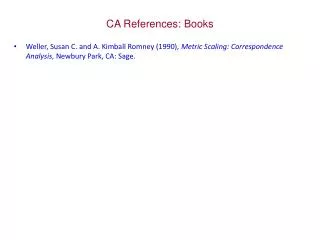
CA References: Books • Weller, Susan C. and A. Kimball Romney (1990), Metric Scaling: Correspondence Analysis, Newbury Park, CA: Sage.
CA References: Articles • Carroll, J. Douglas, Paul E. Green, and Catherine M. Schaffer (1986), “Interpoint Distance Comparisons in Correspondence Analysis,” Journal of Marketing Research, 23 (August), 271-280. • Carroll, J. Douglas, Paul E. Green, and Catherine M. Schaffer (1987), “Comparing Interpoint Distances in Correspondence Analysis: A Clarification,” Journal of Marketing Research, 24 (November), 445-450. Applications: • Iacobucci, Dawn and Amy Ostrom (1996), “Commercial and Interpersonal Relationships: Using the Structure of Interpersonal Relationships to Understand Individual-to-Individual, Individual-to-Firm, and Firm-to-Firm Relationships in Commerce,” International Journal of Research in Marketing, 13, 53-72.