Solving Linear Systems by Graphing: Understanding Equations with Two Variables
80 likes | 207 Vues
This document provides a comprehensive guide to solving systems of two linear equations in two variables (x and y) using graphing methods. It explains how to find the solution, represented as an ordered pair (x, y), by checking whether the equations produce intersecting lines, the same line, or parallel lines. Each type of intersection leads to a different conclusion about the solutions available—ranging from a single solution to infinitely many or no solutions. Practical examples illustrate these concepts, making it easier to grasp graphing techniques in solving linear equations.


Solving Linear Systems by Graphing: Understanding Equations with Two Variables
E N D
Presentation Transcript
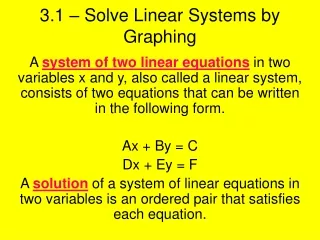
System of 2 linear equations(in 2 variables x & y) • 2 equations with 2 variables (x & y) each. Ax + By = C Dx + Ey = F • Solution of a System – an ordered pair (x,y) that makes both eqns true.
(1,4) 1-3(4)= -5 1-12= -5 -11 = -5 *doesn’t work in the 1st eqn, no need to check the 2nd. Not a solution. (-5,0) -5-3(0)= -5 -5 = -5 -2(-5)+3(0)=10 10=10 Solution Ex: Check whether the ordered pairs are solns. of the system.x-3y= -5-2x+3y=10
Solving a System Graphically • Graph each equation on the same coordinate plane. (USE GRAPH PAPER!!!) • If the lines intersect: The point (ordered pair) where the lines intersect is the solution. • If the lines do not intersect: • They are the same line – infinitely many solutions (they have every point in common). • They are parallel lines – no solution (they share no common points).
Ex: Solve the system graphically.2x+4y=12x+2y=6 • 1st eqn: x-int (6,0) y-int (0,3) • 2ND eqn: x-int (6,0) y-int (0,3) • What does this mean? the 2 eqns are for the same line! • ¸ many solutions
Ex: Solve graphically: x-y=5 2x-2y=9 • 1st eqn: x-int (5,0) y-int (0,-5) • 2nd eqn: x-int (9/2,0) y-int (0,-9/2) • What do you notice about the lines? • They are parallel! Go ahead, check the slopes! • No solution!
hmwk: 142-143/3-51 mult. of 3