
Analysis of Force Distribution in Easy Strutter Functional Orthosis System vs. Axillary Crutches
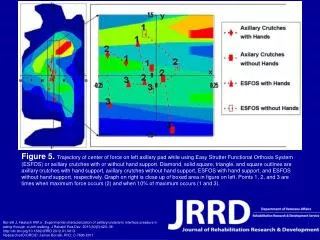
This study investigates the trajectory of force exerted on the left axillary pad while utilizing the Easy Strutter Functional Orthosis System (ESFOS) and axillary crutches, with and without hand support. The trajectories are represented by different shapes for clarity. Key points indicate times of maximum force and when 10% of this maximum occurs, providing crucial insights for rehabilitation practices. The detailed findings contribute to a deeper understanding of interface pressure during swing-through crutch walking, enhancing the design and utilization of mobility aids.

Analysis of Force Distribution in Easy Strutter Functional Orthosis System vs. Axillary Crutches
E N D
Presentation Transcript
Figure 5. Trajectory of center of force on left axillary pad while using Easy Strutter Functional Orthosis System (ESFOS) or axillary crutches with or without hand support. Diamond, solid square, triangle, and square outlines are axillary crutches with hand support, axillary crutches without hand support, ESFOS with hand support, and ESFOS without hand support, respectively. Graph on right is close up of boxed area in figure on left. Points 1, 2, and 3 are times when maximum force occurs (2) and when 10% of maximum occurs (1 and 3). Borrelli J, Haslach HW Jr. Experimental characterization of axillary/underarm interface pressure in swing-through crutch walking. J Rehabil Res Dev. 2013;50(3):423–36. http://dx.doi.org/10.1682/JRRD.2012.01.0013 ResearcherID/ORCID: James Borrelli, PhD: C-7690-2011