1 / 0
A Comprehensive 5-Themes Analysis of The Philippines
0 likes | 118 Vues
This analysis explores the Philippines through five distinct themes: location, place, human-environment interaction, movement, and region. Using absolute and relative location data, the study pinpoints the country’s geographic coordinates and contextualizes its significance. The Philippines lies between 4° 40' – 21° 10'N latitude and 116° 40' – 126° 34'E longitude, featuring a rich cultural and environmental tapestry. This framework provides insights into how geographical aspects influence life in the Philippines, serving as a valuable resource for understanding its diverse landscapes and communities.
Télécharger la présentation
A Comprehensive 5-Themes Analysis of The Philippines
An Image/Link below is provided (as is) to download presentation
Download Policy: Content on the Website is provided to you AS IS for your information and personal use and may not be sold / licensed / shared on other websites without getting consent from its author.
Content is provided to you AS IS for your information and personal use only.
Download presentation by click this link.
While downloading, if for some reason you are not able to download a presentation, the publisher may have deleted the file from their server.
During download, if you can't get a presentation, the file might be deleted by the publisher.
E N D
Presentation Transcript
-
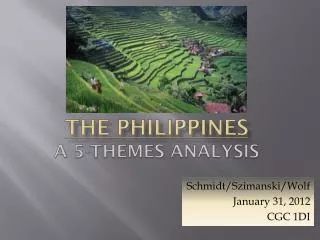
The PhilippinesA 5-themes Analysis
Schmidt/Bergey/Wolf January 31, 2012 CGC 1PI -
Location Theme
Absolute Relative Google Earth - Location - Absolute 4° 40' and 21° 10'N Latitude 116° 40' and 126° 34' E Longitude Equator http://en.wikipedia.org/wiki/Philippines
- Location – Relative South China Sea Taiwan Southeast Asia Pacific Ocean Celebes Sea Google Map
-
Place Theme
Physical - Human http://philembassy-bahrain.com/the-philippines - Place Theme – PhysicalLandforms/Geology 7107 islands 5th longest coastline Mostly mountainous interior of volcanic origin highest peak Mount Apo 2,954 m http://en.wikipedia.org/wiki/Philippines#Geography
- Place Theme – PhysicalClimate Tropical climate March to May is hot and dry. June to October is rainy. Typhoons (hurricanes)are common. November to February is cool. Boracay Island Resort nbcnews.com Super Typhoon Bopha, Sunday, Dec. 2, International Space Station http://www.nasa.gov
- Place Theme – PhysicalVegetation Original jungle is preserved on some islands but much is lost to logging. Dipterocarp 40-50 species of this tropical tree Half only found in Philippines http://www.philippines.hvu.nl/forest1.htm The Philippine Tropical Forest Foundation
- Place Theme – PhysicalWildlife One of the top 10 most biologically diverse countries. Philippine Tarsier One of the smallest primate No taller than 16cm Endangered Often kept as pets Mindoro Crocodile Freshwater croc Critically endangered from dynamite fishing Visayan Warty Pig Named after 3 warts on face Critically endangered from hunting http://en.wikipedia.org/wiki/Philippines
- Place Theme – HumanNational Flag This flag can indicate a state of war if it is displayed with the red side on top Eight Rays 3 main regions Luzon Visayas and Mindanao http://en.wikipedia.org/wiki/Flag_of_the_Philippines
- Place Theme – HumanDemographics Stage 2 Pyramid Birth Rate 25 Death Rate 5 Growth Rate 1.9% Fertility Rate 3.2/woman https://www.cia.gov
- Place Theme – Human Quality of Life Literacy Rate 92.6% School life expectancy = 12 years New policy since 2012, many schools overcrowded Life Expectancy Males 69 Females 75 http://en.wikipedia.org http://wbi.worldbank.org GDP per capita $4300 https://www.cia.gov tourism.gov.ph
- Place Theme – HumanCulture http://en.wikipedia.org/wiki/Philippines Language “Filipino” Tagalog Kung paanoikaw ay “How are you?” Singang (sour and savoury soup or stew) Adobo (marinade of vinegar and garlic, http://translate.google.com/?tl=tl 80% Catholic Lechón(roasted suckling pig) T’boli B’laan Many indigenous groups Basilica Minore del Santo Niño http://www.lonelyplanet.com/philippines http://www.ethnicgroupsphilippines.com/
-
Region Theme
National Global - Region Theme - National Capital City - Manila The Philippines is divided into three island groups and 17 regions.
- Region Theme - Tourism Puerto Princesa Subterranean River National Park, Palawan longest in the world (8.2 km) Limestone geology Endangered species San Agustin Church in Paoay Built 1710 one of the most outstanding “earthquake baroque” structures http://www.tourism.gov.ph Ati-atihan, Kalibo, Aklan, January Honors Santo Niño (Infant Jesus) PHILIPPINES - Exercise a high degree of caution There is no nationwide advisory in effect for the Philippines. However, you should exercise a high degree of caution due to an ongoing terrorist threat to Westerners and Western interests http://travel.gc.ca/travelling/advisories
-
Movement Theme
People Ideas Goods - Movement Theme – PeopleMigration Internally displaced Persons (approx.843,000) Dispute between Muslim rebel group of Mindanao with government to have an autonomous region. Proposal includes: share of revenues from the extraction of southern resources; its own police force; and sharia law for Muslims only. http://www.economist.com/node/21564611 The largest source country for Canadian immigration 2011= approx. 35,000 people. http://www.statcan.gc.ca/pub/89-621-x/89-621-x2007005-eng.htm
- Movement Theme – PeopleGetting Around Bus & jeepneys (common form of public transport) driving is possibly at its most manic in and around Manila bangka(pumpboats) important to inter-island travel Ferry or fastcraft http://www.lonelyplanet.com/philippines/transport/getting-around
- Movement Theme – GoodsTrade NUT PRODUCTION: Top coconut producing country in the world 340 Million nut-bearing trees 15.2 Billion nuts/year average 43 nuts/tree/year average 26% of agricultural land Philippine Coconut Authority People’s Recovery, Empowerment and Development Assistance
-
Human-Environment InteractionsTheme
Survival for Tribal People - HEIEnvironmental Issue Deforestation threats include: Needs of lumber resource due to severe rural poverty and high GR Mining industry Land conversion (roads, farms) seven percent of original, old-growth, closed-canopy forest left Conservation International
- HEI – World Heritage SiteRice Terraces of the Philippine Cordilleras Rice terraces higher altitude and steeper slopes than many other terraces intricate irrigation systems, harvesting water from the forests of the mountain tops an elaborate farming system built 2000 years ago illustrate a persistence of cultural traditions http://travel.nationalgeographic.com/travel/world-heritage
More Related